
City guide
Bordeaux
Use the places and landmarks in this guide to plan visits at your own pace.
Read the guide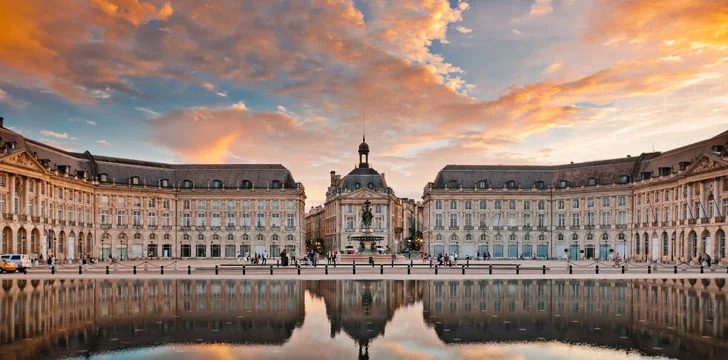
What to discover
Things to see in Bordeaux
Bordeaux developed beside the Garonne, and many of its principal landmarks reflect the wealth generated by eighteenth-century commerce. That prosperity was also tied to the slave trade, a history addressed in the Musée d’Aquitaine. The city’s streets bring this complex past together with medieval gates, Gothic churches and later civic architecture.
The riverfront and the eighteenth-century city
Place de la Bourse faces the Garonne and is an example of eighteenth-century classical planning. Ange-Jacques Gabriel, an architect to the king, designed it in the 1730s. Mythological details on the buildings include figures of Neptune and Bacchus. The Miroir d’eau in front of the façades creates their familiar reflection at ground level.
Close by, Place du Parlement was laid out in an Italian-influenced style during the second half of the eighteenth century. It took its name from the former Parlement of Bordeaux, abolished during the Revolution. Golden limestone paving, restored in the 1980s, sits below ornamented façades and wrought-iron balconies; a Second Empire fountain occupies the centre.
The Grand Théâtre was designed by Victor Louis and inaugurated in 1780 with Racine’s Athalie. Its neoclassical exterior introduces an Italian-style auditorium with blue and gold decoration and white marble. The auditorium has more than a thousand seats.
Palais Rohan began as the archbishop’s palace in the same century. Its restrained Louis XVI design includes an Ionic portico and a columned façade. The building later accommodated the prefecture and Napoleon’s imperial palace before becoming the city hall in 1835.
Gateways, towers and churches
Porte Cailhau was the principal medieval entrance to Bordeaux. Built in the fifteenth century, the 35-metre gate bears a shield with fleurs-de-lis held by two angels. Its name is linked to calhaus, the Gascon word for stones, while its decoration commemorates Charles VIII and the Battle of Fornovo.
Another former entrance, the Grosse Cloche, is the belfry of the old town hall. The fifteenth-century structure consists of two crenellated towers joined by a central section and topped by a golden leopard. Its bell warned of fires and also signalled the beginning of the grape harvest. Pilgrims travelling towards Santiago de Compostela once passed through the gate.
Saint-André Cathedral is the city’s most imposing Gothic church. Its separate Pey Berland tower was built in the second half of the fifteenth century and rises to 66 metres. A bell weighing more than eight tonnes hangs beneath a gilded statue of the Virgin and Child, installed after a storm destroyed the earlier spire in the eighteenth century.
At Saint-Michel, the flamboyant Gothic basilica has another freestanding bell tower, more than 100 metres high. The church contains a fifteenth-century Pietà and an eighteenth-century sculpture of Saint Ursula.
Squares, streets and the city’s history
Place des Quinconces dates from the nineteenth century. Its name comes from the staggered pattern of trees covering much of the space. Rostral columns mark its ends, and the Monument aux Girondins recalls the Girondin political group of the French Revolution.
The arched Pont de Pierre crosses almost 500 metres of the Garonne and was built on Napoleon’s orders. Rue Sainte-Catherine instead cuts through the centre on land, running for more than a kilometre between the Grand Théâtre and Place de la Victoire. Architect Jean-Michel Wilmotte directed a large redevelopment of the street in the early 2000s.
The Musée d’Aquitaine documents the city’s history through collections covering archaeology and ethnology as well as historical material. They include more than five thousand works and objects from Africa connected with Bordeaux’s port history. A permanent section added in 2009 examines the city’s role in the slave trade.
Keep exploring
More guides from the same area to help you continue your search.