
Things to see in Vichy
Vichy is an Allier spa town shaped by its mineral springs, its expansion under Napoleon III and its complex place in Second World War history. The central spa quarter brings together Belle Époque leisure architecture, covered galleries and landscaped parks, while the banks of the Allier give the town a broad green edge.
The opera and spa quarter
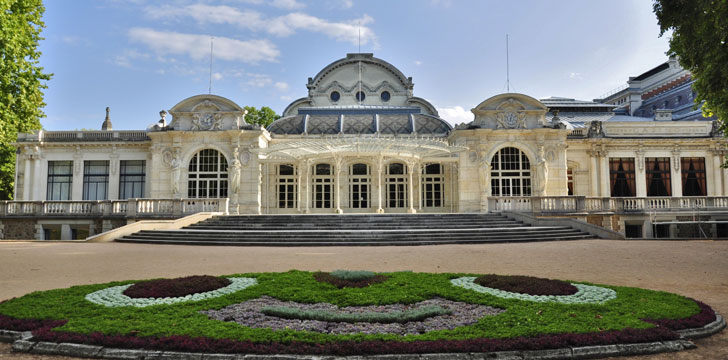
The opera house opened in 1903 with a performance of Verdi’s Aida. Designed by Charles Le Cœur as part of a larger complex on the site of the Grand Casino, its auditorium has more than 1,400 seats. Léon Rudnicki created the Art Nouveau decoration, and portraits of performers, including Sarah Bernhardt, appear inside the dome. The building recalls the period when spa visitors supported resident theatre and music companies.
Nearby, the Parc des Sources grew around the thermal springs. Its development began in the early 19th century, followed by additions under Napoleon III that included kiosks, a source hall and a casino. A covered metal gallery encloses the park. The Hall des Sources, built in wood and metal in 1902 and substantially altered in 1977, brought together waters from the Célestins, Grande Grille, Chomel, Hôpital and Lucas springs.
Thermal architecture
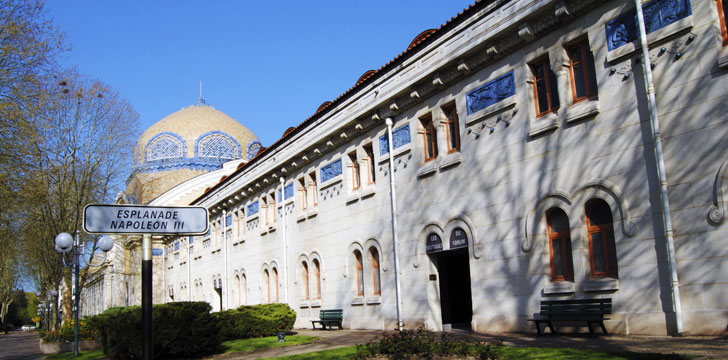
The Thermes des Dômes are a prominent legacy of Vichy’s Belle Époque spa culture. The neo-Byzantine building has a façade more than 170 metres long, a characteristic dome and interior frescoes by Alphonse Osbert. The architecture, rather than any claimed health outcome, is the enduring point of interest.
The Célestins spring takes its name from a 15th-century convent, of which only limited remains survive. Water emerges from the spring at about 22°C and is channelled to the Hall des Sources. It is also associated with the mineral water bottled under the Vichy name at nearby Saint-Yorre. Visitors should rely on current local guidance before tasting any spring water.
Parks along the Allier
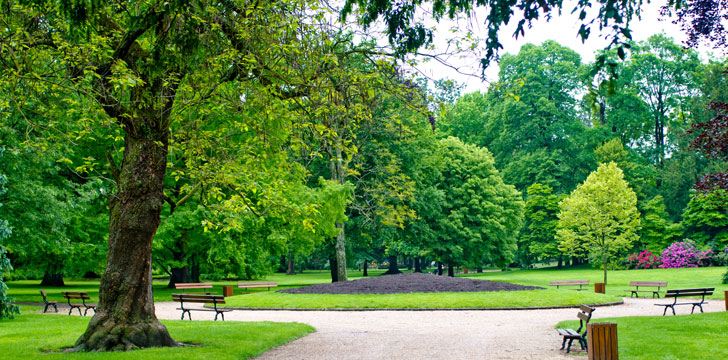
Napoleon III ordered a park beside the river during his second stay in Vichy. It was laid out on an embankment built to protect nearby homes from flooding; later enlargement extended the park to roughly 2.5 kilometres. Its planted landscape includes trees of varied origin, glasshouses and the small Chalet des Suppliques, formerly the park keeper’s house.
Parc Kennedy continues this green corridor. Its planting includes hundreds of trees and dozens of plant species, among them an Osage orange introduced in 1812 from the Mississippi region of the United States. Together, the two parks provide a different setting from the formal buildings of the spa quarter.
Church, collections and historical landmarks
Saint-Louis Church was built between 1861 and 1865 at Napoleon III’s request. Its twin square towers give it a neo-medieval outline, while a neo-Gothic rose window stands above the entrance. Nine stained-glass windows by Antoine Lusson depict saints whose names refer to members of the Bonaparte family.
The municipal museum’s recorded collections range from Gallo-Roman archaeology and philately to coins and modern art. Elsewhere in the centre, the Palais des Congrès, Pavillon Sévigné, Albert Londres’s house and the emperor’s chalets add further layers to Vichy’s history. Several buildings were requisitioned by the Vichy government during the German Occupation, an essential part of the town’s past rather than a decorative footnote.