
City guide
Aurillac
Use the places and landmarks in this guide to plan visits at your own pace.
Read the guide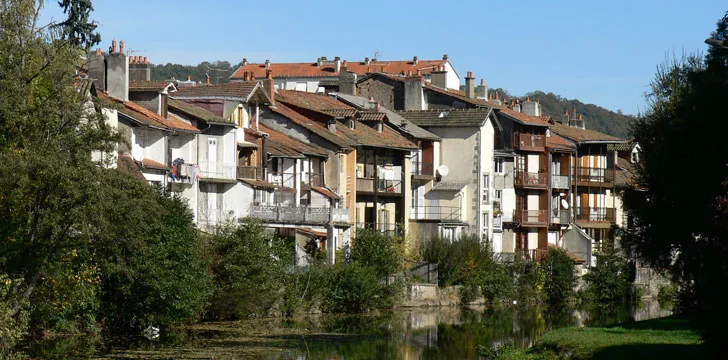
What to discover
Things to see in Aurillac
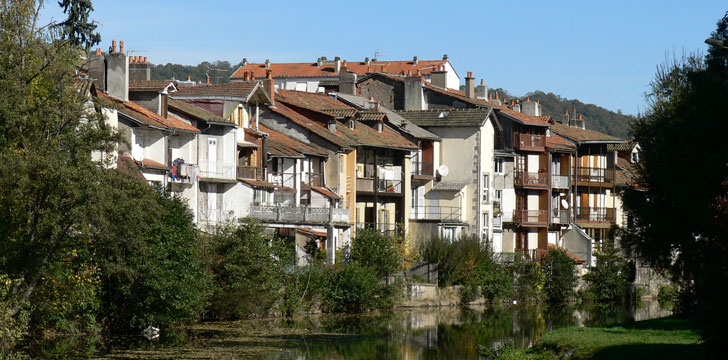
Aurillac lies in the Cantal department of the Massif Central, with much of the town following the River Jordanne. Its compact historic centre is a network of narrow, largely pedestrian streets, where old houses with wooden balconies recall several centuries of urban life. The former tanners’ quarter and the town’s long association with umbrellas sit alongside a more recent cultural identity built around street theatre.
The old town and its churches
The Maison Consulaire is one of the centre’s most distinctive historic buildings. Built in Volvic stone, it combines timber framing with a carved doorway. It housed the communal assembly from 1580 until the French Revolution; after a fire in 1880, it was rebuilt by a follower of Viollet-le-Duc in a blend of Gothic and Renaissance styles. The building also contains a museum devoted to old Aurillac, with engravings and paintings.
Two churches help trace the town’s religious history. Notre-Dame-aux-Neiges began as a 14th-century chapel belonging to a Franciscan convent and preserves a Renaissance lectern, a refined 15th-century chapel and an 18th-century marble Virgin. Saint-Géraud originated as an abbey church founded by the Auvergnat count Géraud at the end of the ninth century. Although little survives of the abbey, the church retains Romanesque remains, an 18th-century organ and a broad nave.
Château Saint-Étienne and the volcanic landscape
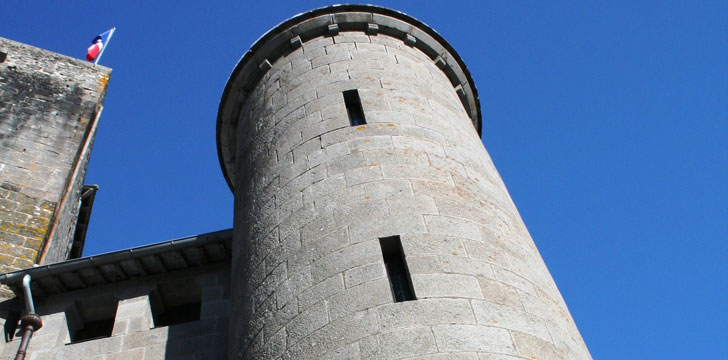
Château Saint-Étienne stands above the town. Its principal medieval survivor is a 13th-century keep, while the terrace opens towards the Jordanne valley, the Cantal mountains and the Aurillac basin. The château houses science and environmental collections, including palaeobotany. Its volcano museum uses models, displays and video across four rooms to explain the geology and volcanic history of the Cantal, with ecology forming part of the account.
Squares, monuments and street theatre
Near the tourist office and Square Arsène Vermenouze, the Human Rights Fountain was inaugurated in 1890 for the centenary of the French Revolution and restored in 2007. Another civic monument honours Gerbert of Aurillac, later Pope Sylvester II and the first French pope; the three-metre bronze was made by David d’Angers, with episodes from his life shown in relief around its base.
Square Arsène Vermenouze occupies the former fairground. Designed by Charles Alphand, also associated with Parc Monceau and Parc Montsouris in Paris, it brings together trees, flower beds, small cascades, fountains, statues and a pond. The square bears the name of an Aurillac poet. The town’s International Street Theatre Festival, founded in 1986 and traditionally held in August, turns streets and squares into performance spaces; dates and programmes should be checked before a visit.
Around Aurillac
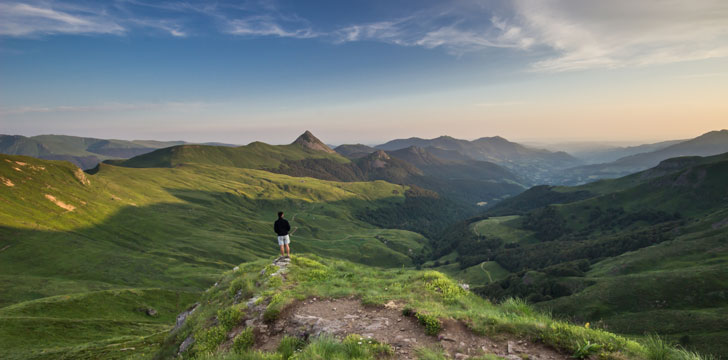
About 15 kilometres away, Château de Pesteils overlooks the Cère valley above Polminhac. The former medieval fortress was altered many times and contains wall paintings and Flemish tapestries. Its terrace looks towards the Plomb du Cantal in clear weather. The wider mountain landscape also includes Puy Mary, high plateaux known as planèzes, traditional stone shelters and paths through the volcanic terrain.
Keep exploring
More guides from the same area to help you continue your search.