
Things to see in Le Puy-en-Velay
Le Puy-en-Velay, the prefecture of Haute-Loire, occupies a steep volcanic setting in Auvergne. Its old streets climb towards a Romanesque cathedral, while chapels and statues crown separate rocky outcrops around the town. Pilgrimage, lace-making and local foods such as Le Puy lentils are all part of its identity.
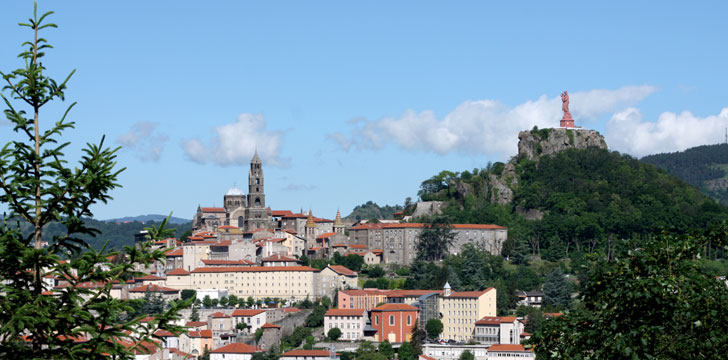
Streets of the upper town
The historic centre rewards a slow ascent. Stepped lanes pass buildings from several periods: the Saint-Jean baptistery behind the cathedral dates from the 10th century; Rue Pannessac has examples of 17th- and 18th-century classical architecture; and Renaissance façades line Rue Courrerie. The town is also closely associated with lacemaking, a craft traditionally practised in view of passers-by during the summer.
Place du Plot has long been a gathering point for pilgrims setting out towards Santiago de Compostela. In earlier centuries, travellers formed groups here before beginning the road together. The square is also linked to regional produce, notably Le Puy lentils and fromage aux artisous. Nearby Place du Martouret was the site of public executions during the French Revolution. Its main civic building is the town hall, completed in 1766 and rebuilt internally after a fire in the 1960s.
Cathedral, cloister and Hôtel-Dieu
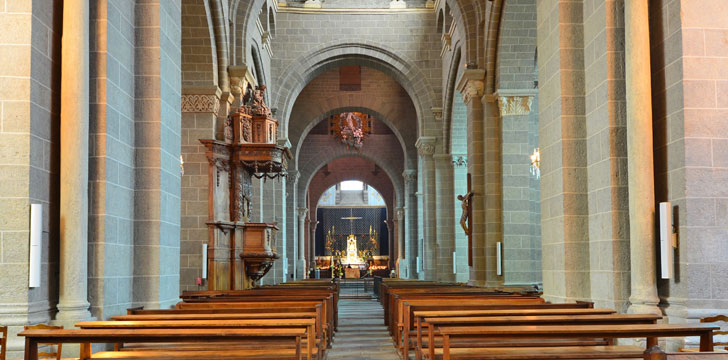
Notre-Dame Cathedral was built from the late 11th to the 13th century. A large staircase leads into the nave, and the façade includes forms influenced by Moorish architecture. The cathedral’s Black Virgin is a replacement: the figure traditionally said to have been brought back by Saint Louis from the Crusades was burnt during the Revolution. The present statue rests on a large 17th-century reliquary.
The rectangular Romanesque cloister dates from the 12th century and was restored by Viollet-le-Duc in the 19th. Its arcades again show Moorish influence, while carved capitals include representations of the seven deadly sins. A building on the west side contains a relic chapel below and a religious-art museum above. In the cathedral’s shadow, the 12th-century Hôtel-Dieu was founded to receive poor and sick people. Jean-Michel Wilmotte later renovated it as a museum and conference space.
Chapels and statues on the rocks
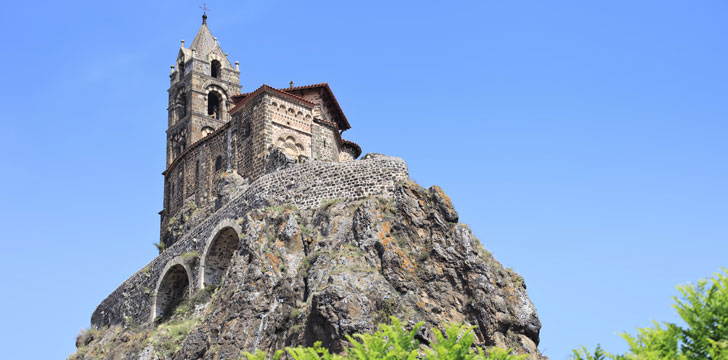
Saint-Michel d’Aiguilhe is a Romanesque chapel built on a rock pinnacle in 969. Its entrance has paired columns and a polylobed arch, with coloured stone mosaics depicting biblical figures above it. The directory entry connects these details with architectural influences that travelled along the pilgrimage roads.
North of the town, Rocher Corneille is a basalt outcrop more than 130 metres high. Jean-Marie Bonassieux’s cast-iron statue of Notre-Dame de France stands at its summit. It was made using metal from guns brought back after the 1854 Siege of Sevastopol; the ochre-coloured figure is 16 metres high, or 22 metres with its pedestal. An internal staircase rises into the statue.
Across the Borne valley, the Rocher Saint-Joseph de Bon Espoir looks over Le Puy and the neighbouring slopes. Chapels occupy caves at the site, and a fortress-like basilica completed in 1918 is dominated by a statue more than 20 metres high.
Gardens, museum and the wider area
Henri Vinay Garden covers more than four hectares and contains mature trees, flower beds and animal enclosures. The Musée Crozatier, founded in 1851 and later enlarged through a gift from Charles Crozatier, stands at the far end. Its collections encompass painting, sculpture and lace from prehistory onwards.
Outside the centre, Polignac fortress occupies a rocky promontory protected by cliffs on three sides and a triple line of walls on the fourth. It was the principal seat of the hereditary Polignac viscounts and could accommodate a large medieval garrison. The town’s Roi de l’Oiseau celebrations also recall an older archery contest, now interpreted through Renaissance costume, street performance and exhibitions.