
Things to see in Clermont-Ferrand
Clermont-Ferrand, the prefecture of Puy-de-Dôme, has a historic centre shaped by churches, civic squares and the union of two former towns. Its position in Auvergne also places the city close to the volcanic landscapes of the Chaîne des Puys.
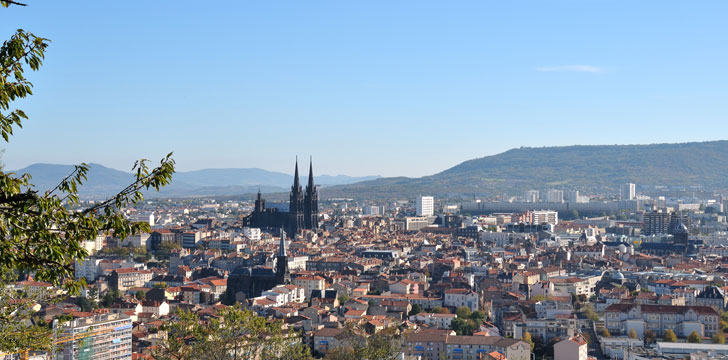
Clermont and Montferrand
The present city grew from Clermont and neighbouring Montferrand, whose union was imposed by Louis XIII. Their different histories are still legible. Clermont contains the principal monuments and squares, while Montferrand retains medieval houses and a more compact historic street pattern.
Montferrand had long been Clermont’s rival and enjoyed royal and fiscal privileges through its loyalty to the kings of France. The district later became closely associated with Michelin. The company’s factories and the housing built for its workers left a distinct mark on this part of the city.
Churches and the cathedral quarter
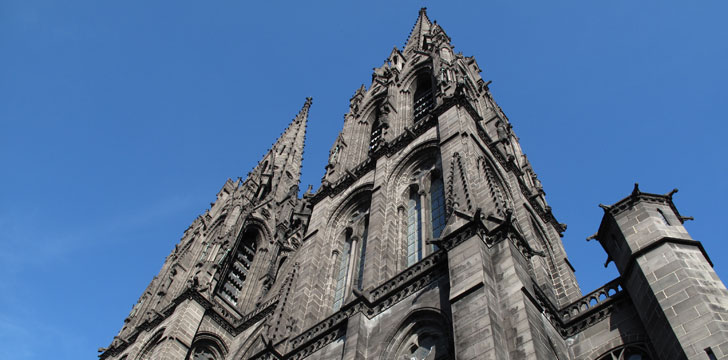
Notre-Dame-de-l’Assomption is the city’s principal Gothic monument. Construction began in the thirteenth century under Jean Deschamps, who also directed work at the cathedrals of Narbonne and Limoges. The design drew on Beauvais and Amiens, while the crypt preserves Romanesque elements. The building was not finally completed until the nineteenth century, when Viollet-le-Duc oversaw the concluding work.
Beside it, Place de la Victoire took shape during the Revolution after ecclesiastical buildings around the cathedral were cleared. The house associated with the philosopher Blaise Pascal was also lost in that operation. A statue of Pope Urban II by Henri Gourgouillon still faces the cathedral; it originally stood above a fountain.
Notre-Dame-du-Port offers a different strand of the city’s religious architecture. The collegiate church was founded in the tenth century and later received basilica status in connection with the routes to Santiago de Compostela. Mosaics decorate the east end, and its painted capitals depict biblical scenes. A programme of restoration in the 2000s cleaned the stonework and conserved paintings inside.
Squares, art and civic architecture
Place de Jaude is Clermont-Ferrand’s main urban square. The Opéra-Théâtre stands on its eastern side, Saint-Pierre-des-Minimes church borders the west, and statues commemorate General Desaix and Vercingetorix. Once urbanised in Roman times but largely open during the Middle Ages, the square became a civic focus in the nineteenth century. Much of it is now pedestrianised, with the tram crossing it.
The opera occupies the site of the former cloth hall. Jean Teillard directed its construction between 1891 and 1894, creating an Italian-style auditorium with a decorated dome, gilding and a ceremonial staircase. Elsewhere in the centre, the early sixteenth-century Fontaine d’Amboise combines Gothic form with Renaissance carving. Chapart made it in Volvic stone for the bishop Jacques d’Amboise.
For fine art, the Musée d’Art Roger-Quilliot occupies a seventeenth-century Ursuline convent in Montferrand. Its permanent displays span the Middle Ages to the twentieth century and include works associated with Corot, Van Loo, Camille Claudel, Picasso and Cocteau.
Parks and the volcanic landscape
Parc Montjuzet covers 26 hectares on a hillside north-west of the centre. Its height opens views over Clermont-Ferrand, while its planting includes Mediterranean and other non-native species. Two large modern works, Takashi Naraha’s Boule erratique and Carlos Cruz-Diez’s Fontaine à induction chimique, add sculpture to the landscape. Jardin Lecoq, below the central plateau in the university quarter, provides another central green space.
About 15 kilometres from the city, the dormant Puy-de-Dôme is one of the defining summits of the Chaîne des Puys. Its gradients make walking and cycling demanding, and scientific installations at the summit include transmission equipment and a weather station. The Plateau de Gergovie, linked to the confrontation between Vercingetorix and Caesar, combines an archaeological site, a Volvic-stone memorial and a permanent exhibition space. Vulcania interprets the Earth and volcanic activity through interactive displays, films and moving platforms.