
City guide
Caen
Use the places and landmarks in this guide to plan visits at your own pace.
Read the guide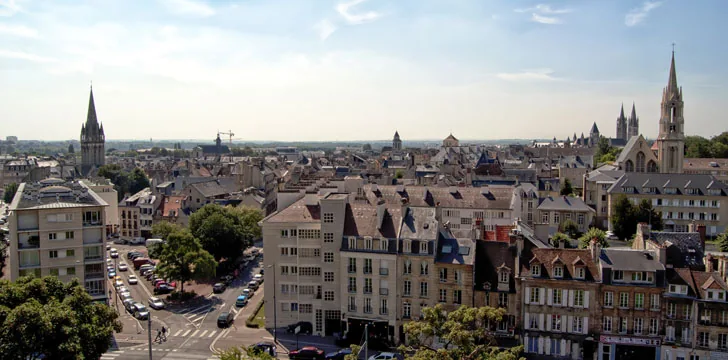
What to discover
Things to see in Caen
Caen’s old centre brings together buildings from more than ten centuries of the city’s history. The legacy of William the Conqueror is especially prominent, but later churches, civic spaces and museums add several other layers. The result is a compact introduction to medieval Normandy, the damage and rebuilding of the twentieth century, and the region’s art and archaeology.
The castle and the two abbeys
The Château de Caen, also known as the ducal castle, was founded by William the Conqueror in 1060 as a citadel overlooking the valley. Its ramparts still give a sense of the scale and position of the fortress. Within the enclosure are the remains of the keep, the church of Saint-Georges and a herb garden. The site also contains two of Caen’s principal museums.
William also founded the Abbaye aux Hommes in Bourg-l’Abbé, the district that took its name from the monastery. The abbey suffered during the Hundred Years’ War and the Wars of Religion; William’s tomb was desecrated in 1562, and parts of the choir collapsed. Reconstruction begun in 1663 gave much of the complex its classical character and formal French garden. The former monastic buildings later became Caen’s town hall.
Across the city, the Abbaye aux Dames was founded by William’s wife, Matilda of Flanders, whose tomb has been there since 1083. Consecrated as the Abbey of the Holy Trinity in 1066, it began as a Benedictine convent for girls from Norman aristocratic families. After its closure in 1792, the complex served in turn as barracks, a hospital and a hospice. Its abbey church is an important example of Norman Romanesque architecture.
Streets, squares and churches
Place Saint-Sauveur has functioned as a public space since the Middle Ages and was Caen’s market square by the twelfth century. Its broad triangular plan is framed by seventeenth-century classical buildings that survived the bombing of the Second World War. A bronze statue of Louis XIV, made by Louis Petitot and dated 1824, stands in the square.
Several churches can be considered as part of a walk through the centre. Saint-Étienne-le-Vieux survives as a ruined tenth-century monument; its east end, main portal, horseman relief and lantern tower can be seen from outside. Notre-Dame-de-la-Gloriette was built by the Jesuits in the seventeenth century and received its present dedication in 1689. Its interior includes a baldachin and high altar dating from 1707.
Saint-Jean, built during the fourteenth and fifteenth centuries, combines Flamboyant Gothic architecture with a conspicuous lean attributed to the marshy ground beneath it. Saint-Pierre took shape over several centuries from the thirteenth century onwards, which accounts for its Rayonnant Gothic, Flamboyant Gothic and Renaissance features. Its spire was destroyed by a shell in 1944 and restored in 1957 to a height of 75 metres.
Museums and a reclaimed landscape
The Mémorial de Caen, inaugurated in 1988 near the Normandy landing beaches, examines twentieth-century war, the Cold War and peace through objects, photographs, film and testimony. Inside the castle, the Musée des Beaux-Arts has paintings from France, Italy, Flanders and the Netherlands, with particular strength in the sixteenth and seventeenth centuries, as well as prints and sculpture.
The castle is also home to the Musée de Normandie. Founded in 1946 as an ethnographic museum, it added an archaeology gallery in 1968; finds from regional excavations trace human activity back to prehistory. Near the memorial, the Colline aux Oiseaux offers a different kind of historical transformation. Opened as a landscaped park in 1994, its 17 hectares occupy the site of a former landfill and include extensive rose planting and a reconstructed Norman farm.
Keep exploring
More guides from the same area to help you continue your search.