
City guide
Alençon
Use the places and landmarks in this guide to plan visits at your own pace.
Read the guide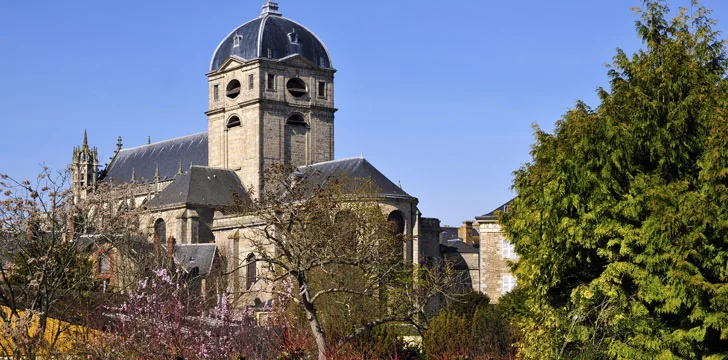
What to discover
Things to see in Alençon
Alençon, the prefecture of Orne, lies where Normandy meets the historic province of Maine. Its origins may reach back to the fourth century, while its reputation for fine lace brought wealth and recognition in the seventeenth. Half-timbered houses, substantial town houses and cobbled lanes make that history legible across the old centre.
Ducal and religious heritage
The Château des Ducs was built in the fourteenth century by Pierre II, Count of Alençon from 1361 to 1404. Most of the fortress has gone, but its imposing gateway and the crowned Tour Giroye indicate the strength of the former citadel. Part of the extensive castle grounds survives as the Parc des Promenades. The park was laid out in 1783 and is the oldest in central Alençon.
Notre-Dame Basilica was built between the fourteenth and sixteenth centuries in what is now the pedestrian quarter. Its richly carved porch is a Norman example of Flamboyant Gothic architecture, arranged around three portals. Inside, sixteenth-century stained glass depicts biblical scenes on the north side and subjects devoted to the Virgin Mary on the south.
The seventeenth-century Jesuit church has an imperial-form roof topped by a hexagonal bell turret. The building also houses an important written collection: manuscripts and books dated from 1500 to 1950, together with several incunabula printed before 1500.
Lace and fine art
The Musée des Beaux-Arts et de la Dentelle occupies the former Jesuit college. Its displays explain the development of Alençon lace, whose particularly refined workmanship overtook Venetian lace in prestige during the seventeenth century. The fine-art collection includes Philippe de Champaigne’s Assumption and Eugène Boudin’s Le Rocher de l’Islette à Antibes.
Lace is central to Alençon’s identity, but the museum places it alongside the city’s broader artistic inheritance rather than treating it as an isolated craft. Its setting in the Jesuit complex also connects the collection with one of the old centre’s main groups of historic buildings.
Houses and civic architecture
Maison d’Ozé is a granite manor built around 1450 for Jean du Mesnil, an alderman of Alençon. A wide porch opens through the main range, with a steep-roofed pavilion attached to it. On the garden side, a turret with a square top overlooks grounds enclosed by sections of the former town walls.
The Hôtel de Ville dates from 1783 and was designed by Jean Delarue. Built in dressed stone in the Louis XVI style, its curved façade is articulated by pilasters and finished with a pediment and balustrades that recall the Petit Trianon. Inside is a large staircase with a nineteenth-century banister.
Another distinctive civic building is the circular Halle au Blé, constructed in stages before the early nineteenth century. A glass dome modelled on the grain hall in Paris was added in 1865. Initially used for the grain trade, the hall served as a hospital during the First World War and later accommodated fairs, markets and public activities.
Together, these sites show Alençon beyond a single period: remnants of ducal power sit near late Gothic architecture, a Renaissance-era house and eighteenth-century civic planning. The compact old centre allows their different materials and building forms to be read in close succession.
Keep exploring
More guides from the same area to help you continue your search.