
Things to See in Chartres
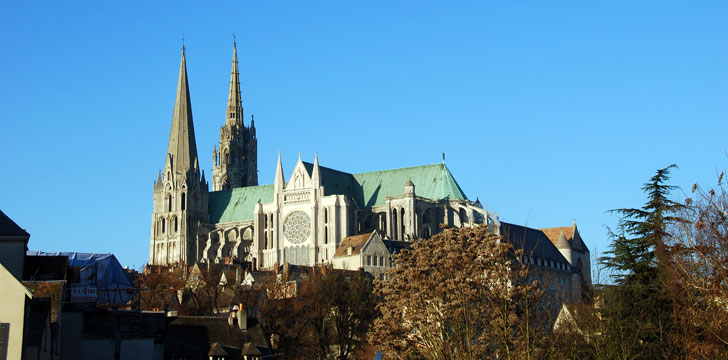
Chartres is the prefecture of Eure-et-Loir in the Centre region, less than 100 kilometres from Paris. Its identity is closely tied to pilgrimage and Notre-Dame Cathedral, but the city is not confined to a single monument. The historic centre descends from the upper town around the cathedral to the lower town beside the Eure, creating a compact sequence of religious buildings, museums, gardens and old commercial streets.
The cathedral and upper town
Notre-Dame de Chartres was built between 1145 and 1220. Its fabric records the transition from Romanesque construction to Gothic architecture, and it remains one of the country’s most complete surviving Gothic buildings. Inside are two crypts and a stone labyrinth set into the floor. The cathedral also has a place in French literature, notably in the work of Charles Péguy.
Behind the cathedral, the Jardins de l’Évêché surround the Collégiale Saint-Étienne. Their formal layout provides a pause from the enclosed streets, with views over the old town, the banks of the Eure and the outskirts of Chartres. The nearby Musée des Beaux-Arts occupies the former episcopal palace, a building developed between the fifteenth and eighteenth centuries. Its varied holdings range from paintings, drawings and sculpture to sacred enamels, archaeology, furniture, harpsichords and works from Africa and Oceania. Artists represented in the collection include Corot, Fragonard, Sérusier and Van Loo.
The old town and the Eure
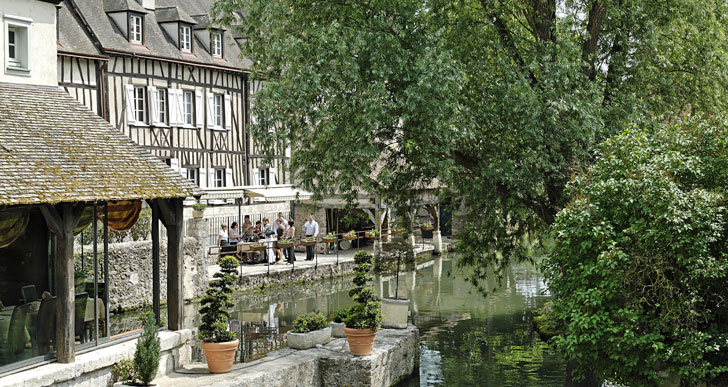
The old town has two distinct levels: the upper streets beside the cathedral and the lower quarter laid out along the river. Medieval timber-framed buildings preserve evidence of the area’s trading past. Two named examples, the Maison du Saumon and the Maison de la Truie qui file, were used by fish sellers until the 1950s. They survived when the neighbouring timber-framed group was demolished during the following decade.
Saint-Pierre Church adds another layer to this part of Chartres. The thirteenth-century church replaced an abbey that had fallen into ruin after being sacked by the English. Later additions gave the complex its mixed appearance. Confiscated during the Revolution and used as a saltpetre works, the church returned to worship in 1803. For a quieter riverside interlude, the Parc des Bords de l’Eure follows the water with green space for walking and resting.
Mosaics and stained glass
Maison Picassiette is the work of Raymond Isidore, who covered his home with mosaics assembled from fragments of broken plates collected from rubbish tips. The interiors and decorative scenes, including recurring daisies, became an individual example of naïve art. Once mocked, Isidore’s project outlived him and is now one of Chartres’ most distinctive works.
The Centre International du Vitrail approaches stained glass as art, craft and a field of research. It combines museum displays with documentation and cultural activity, presenting work by recognised international artists alongside makers from the region. The directory entry notes that gas and electricity have made production easier while the underlying craft techniques have changed little since the twelfth century.
Château de Maintenon
A broader visit to the area can include Château de Maintenon, associated with the Marquise de Maintenon and Louis XIV. Originally defensive in character, it was altered over successive periods into a more aristocratic residence. An aqueduct crossing its gardens is the most conspicuous reminder of the royal works undertaken there.