
Things to see in Tours
Tours has developed beside the Loire while retaining buildings from its years as a royal city. The historic quarters do not belong to one period: medieval religious foundations, Renaissance stonework, civic squares and nineteenth-century collections all contribute to the centre seen today. Several principal sites stand close to Cathédrale Saint-Gatien, while Vieux-Tours forms another focus farther west.
Around Saint-Gatien
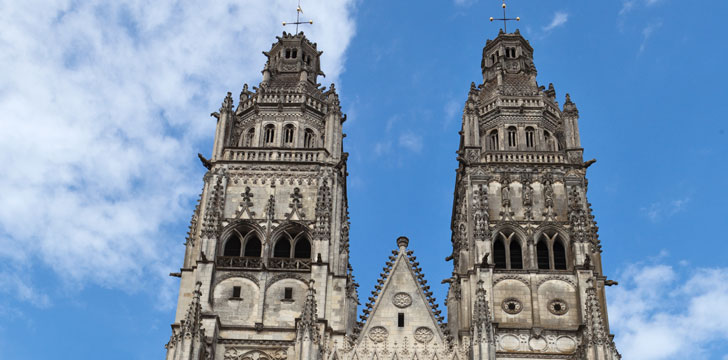
Cathédrale Saint-Gatien rises over the centre with a Gothic façade and towers reaching 70 metres. The building stands on the site of a sanctuary dating back to the fourth century. Work continued across a long period, including alterations under Saint Louis, and was completed after the Hundred Years’ War. Inside are the marble tomb of two sons of Charles VIII, an organ case decorated with carved angels and stained glass associated with the era of Saint Louis.
Adjoining the cathedral, the Cloître de la Psalette combines Gothic and Renaissance work. Construction began in 1442 for the canons of Saint-Gatien, whose illuminated manuscripts brought recognition to their community. A Renaissance staircase and much earlier stained glass are among the details that distinguish the cloister.
The Musée des Beaux-Arts occupies the former archbishop’s palace nearby. The listed building incorporates layers of earlier history, including underground inscriptions dating from the fourth century. Its collections grew from works assembled during the French Revolution, supplemented by private gifts, bequests and transfers from the Louvre. Artists represented include Boucher, Ingres, Delacroix, Rubens and Rembrandt, whose Flight into Egypt is held in the museum’s collection.
The Loire-side castle and Saint-Martin
Close to the cathedral on the bank of the Loire, the Château de Tours evolved from a modest aristocratic residence of the fifth century into a royal castle in the thirteenth. It was later known as the Palais des Gouverneurs and Caserne Meusnier. The surviving Tour de Guise retains medieval machicolations, while the restored complex has been used for art exhibitions rather than presented as a conventional furnished château.
Basilique Saint-Martin belongs to the early twentieth century, although it occupies the site of a much older Christian sanctuary. Its Romano-Byzantine design differs from the city’s Gothic churches. Large stained-glass windows recount episodes from the life of Saint Martin, bishop of Tours, and from church history; the crypt contains a reconstruction of his tomb.
Vieux-Tours and its collections
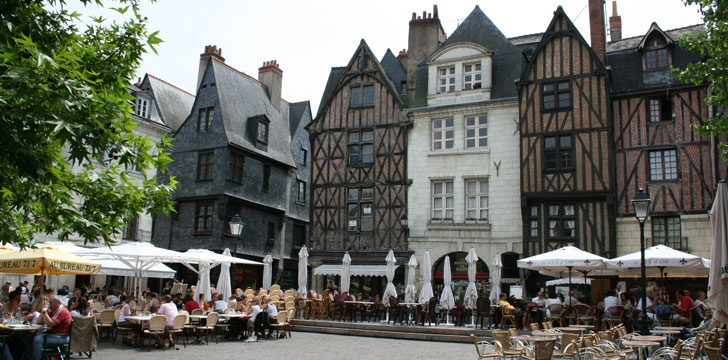
Near the Loire, Place Plumereau is framed by restored half-timbered houses. The surrounding quarter was rehabilitated in the 1960s and is now one of the clearest places to read the domestic architecture of old Tours. Its active street level contrasts with the preserved upper façades.
On Rue du Commerce, Hôtel Goüin dates from the middle of the fifteenth century and takes its name from the banking family who acquired it in the eighteenth. Bombing in 1940 damaged the building, which was partly reconstructed after the war. Its finely worked Renaissance limestone façade and loggia are the main surviving architectural features.
The Musée du Compagnonnage occupies dependencies of the former Abbaye Saint-Julien. Its subject is the French journeyman tradition: reception masterpieces are shown with the tools, insignia and archives of the compagnons. The collection places skilled craftwork within the social history of the Compagnons du Tour de France.
Civic spaces and the botanical garden
Place Jean-Jaurès sits where Boulevard Heurteloup, Boulevard Béranger, Rue Nationale and Avenue de Grammont meet. Created in 1745 at the edge of the former fortifications, it is bordered by the town hall and the colonnaded law courts, with two fountains set within its planted space.
West of the centre, opposite Hôpital Bretonneau, the botanical garden was laid out between 1831 and 1843. It covers about five hectares along Boulevard Tonnellé. A magnolia-lined avenue, medicinal-plant garden and glasshouses give the grounds an educational role as well as providing a distinct change of scale from the stone streets of central Tours.