
Things to see in Châteauroux
Châteauroux, the administrative centre of Indre, lies where the natural areas of Champagne Berrichonne, Boischaut and Brenne meet, about 250 kilometres from Paris. The city’s story can be followed through a medieval castle, churches, reused religious buildings and museums devoted to local and wider history.
A town formed around Château Raoul
Château Raoul is closely tied to the origin of Châteauroux. A stronghold established around 1100 encouraged craftspeople and merchants to settle nearby, giving the growing town both its focus and its name. It first served as a powerful fortress under the Déols. The castle was destroyed by fire in 1367 and rebuilt around 1450. Listed as a historic monument in 1927, it had passed into public ownership in 1792 and subsequently took on an administrative role.
The expansion that began around the castle eventually absorbed Saint-Martial church, which had originally stood beyond the town walls as a dependency of the parish church of Saint-Denis. Built in stages between the twelfth and sixteenth centuries, Saint-Martial was listed as a historic monument in 1921.
Churches in the centre
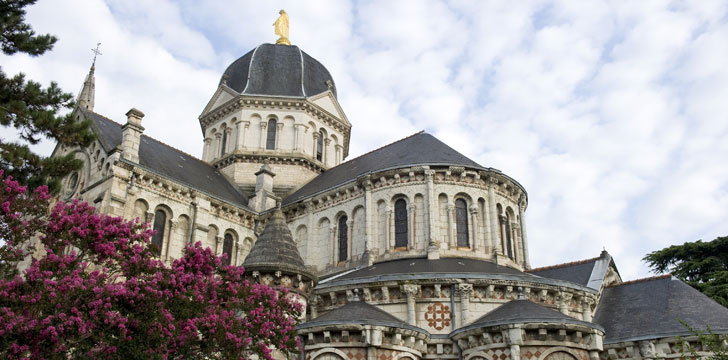
Saint-André belongs to a later phase of the city’s religious architecture. Constructed between 1869 and 1876, it replaced an earlier church demolished during the Revolution. The nineteenth-century building is neo-Gothic and cathedral-like in scale, although it is not a cathedral. Notre-Dame church provides another prominent element in the city’s church architecture.
Historic buildings with new uses
Franciscans founded the Couvent des Cordeliers in the thirteenth century. After being damaged during the Revolution, the complex served successively as a barracks, prison, gendarmerie and school. A restoration completed in 1978 prepared it for contemporary-art exhibitions, including displays devoted to ceramics. Its terraced gardens overlook the Indre, connecting the former convent with the river landscape below.
The Musée-Hôtel Bertrand occupies the eighteenth-century town house of General Bertrand, Napoleon I’s companion in arms. Its collections bring together Egyptian archaeology, Napoleonic material and contemporary art. Among the works identified with the museum are Napoleon’s aviary and Flemish and Dutch paintings dating from the fifteenth and seventeenth centuries.
At the Maison du Berry, the focus shifts to regional life. Traditional costumes, paintings and everyday objects present the material culture of Berry. The building formerly housed the stables of the city’s cloth factory and has accommodated the museum, alongside musical and ethnological associations, since 1992. It stands in Parc Balsan.
Châteauroux forest
South of the city, the state forest of Châteauroux extends across more than 5,000 hectares. Oak woodland provides habitat for deer, roe deer, wild boar and squirrels. The forest is also used for walking, mountain biking and horse riding, making the wooded landscape a substantial contrast to the monuments and museums of the centre.