
Things to see in Orléans
Orléans lies in the Loire Valley, in the Loiret department of central France. It was one of the country’s wealthiest cities during the Middle Ages, alongside Paris and Rouen, and its streets retain evidence of royal, religious and civic history. Joan of Arc’s role in lifting the siege of 1429 remains central to the city’s identity, but the surviving landmarks span a much wider period.
Sainte-Croix and Joan of Arc
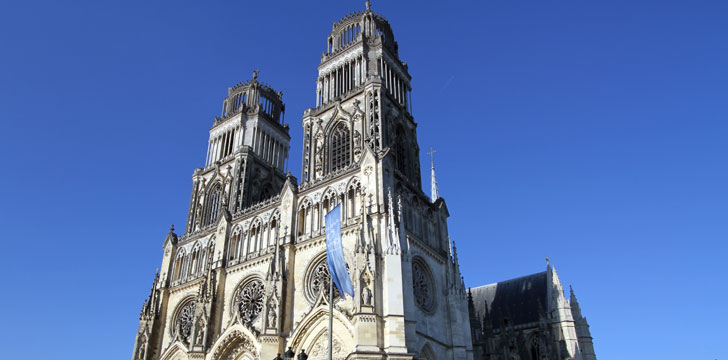
Cathédrale Sainte-Croix is a Gothic building with two square bell towers. Earlier fabric survived the Hundred Years’ War but suffered heavily during the Wars of Religion. Reconstruction under the Bourbons began in the early seventeenth century, and the present cathedral was not completed until 1829. That extended history accounts for a building whose Gothic appearance is the product of several centuries.
The Maison de Jeanne d’Arc recalls a more specific episode. The present half-timbered house is a reconstruction from the 1960s of the home in which Joan stayed between April and May 1429 during the siege. The original belonged to Jacques Boucher, treasurer-general to the duke. Displays in the reconstructed building trace Joan’s life and the way Orléans has preserved her memory.
Renaissance and civic Orléans
Hôtel Groslot is a Renaissance townhouse linked to the architect Androuet du Cerceau and to Jérôme Groslot. Its distinguished guests included Mary, Queen of Scots, Henri III and Henri IV; François II stayed there with his court for almost five months. The municipality acquired the building after the French Revolution. Balzac later referred to it in Sur Catherine de Médicis, part of La Comédie humaine.
Place du Martroi is the central square of the city centre. Denis Foyatier drew up its nineteenth-century form, and the square was later badly damaged by bombing during the Second World War. Archaeological investigations preceded the construction of an underground car park and its subsequent remodelling. The tram once again crosses the square, echoing its route in the nineteenth century.
Religious history and collections
Collégiale Saint-Aignan has been rebuilt repeatedly. Its dedication refers to the saint traditionally credited with delaying Attila’s attack on Orléans in 451 until Roman reinforcements arrived. The church was confiscated during the Revolution and returned to Catholic worship in 1802 following the Concordat. Its crypt once held relics of Saint Aignan, which were destroyed during the Wars of Religion.
Founded in 1823, the Musée Historique et Archéologique de l’Orléanais holds the Treasure of Neuvy-en-Sullias, a group of bronze statues and statuettes from the Gallic and Gallo-Roman periods. Other displays address medieval architecture through pieces such as stucco work and carved capitals, including an example from the abbey of Saint-Benoît-sur-Loire.
Parc Floral de la Source
South of the centre, the Parc Floral de la Source introduces a contrasting landscape. Urban planner Louis Arretche designed the park in 1963 across 35 hectares of undulating ground. Its layout brings cultivated plant collections and glasshouses alongside semi-natural oak and hornbeam woodland. The changing levels allow these areas to sit together without imposing a rigidly formal plan, making the park distinct from the dense historic core of Orléans.