
City guide
Troyes
Use the places and landmarks in this guide to plan visits at your own pace.
Read the guide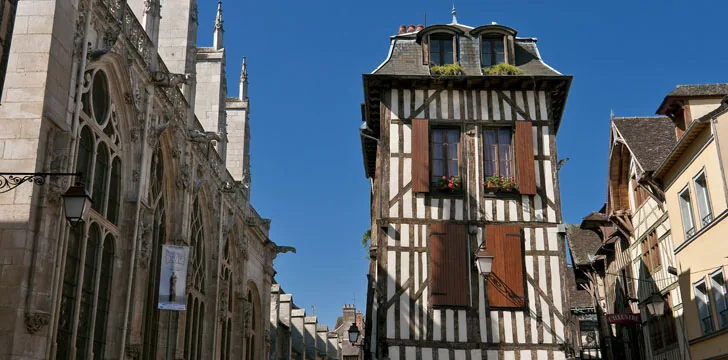
What to discover
Troyes: Historic Streets and Churches
The historical capital of Champagne, Troyes has a compact centre best explored on foot. Its lanes bring together timber-framed houses, religious buildings and Renaissance town houses from several periods. The city is designated a Ville d’Art et d’Histoire, and much of its architectural record can be read within the old town.
The Champagne cork old town
Seen from above, central Troyes has an outline often compared to a Champagne cork. At street level, its most characteristic buildings are the timber-framed houses of the 16th and 17th centuries. Some retain chestnut-wood shingles, while narrow passages lead towards internal courtyards such as the Cour du Mortier d’Or.
The Ruelle des Chats is the clearest example of how tightly this quarter developed. Upper storeys project beyond the ground floors until the roofs almost touch across the lane, traditionally allowing cats to cross from one side to the other. This form of construction also increased living space when tax was calculated from a house’s footprint. Parts of the paving are original, and a carved cat’s head can be found on one of the beams.
Rue Émile Zola, known in the Middle Ages as Rue de l’Épicerie, has long been one of the centre’s main commercial streets. It runs between Place Jean Jaurès and Place de la Préfecture through the main body of the cork-shaped district. Alongside its timber façades, the street gives access to the courtyard of the Hôtel du Lion Noir at number 111.
Gothic churches and stained glass
The history of the Cathédrale Saint-Pierre-et-Saint-Paul reaches back to around the year 1000. A fire damaged the earlier building in 1188; reconstruction began around 1200 and continued into the 17th century. Its Gothic façade has three 16th-century portals. The north tower, dedicated to Saint Peter, was completed in 1634, but the planned south tower was never built. Inside, the cathedral has about 1,500 square metres of stained glass, including a rose window eight metres in diameter.
Église Sainte-Madeleine, built between the 13th and 16th centuries, is the oldest church in Troyes and was listed as a historic monument in 1840. Its stone rood screen was carved by Jean Guailde in the early 16th century with exceptionally fine openwork. Stained-glass scenes from the same century include the Creation and the Tree of Jesse, in a style associated with the Champagne school.
Basilique Saint-Urbain has a direct link with Jacques Pantaléon of Troyes, elected Pope Urban IV in 1261. He ordered a church on the site where his father had kept a cobbler’s shop. Built from 1262 to 1286 in a restrained Gothic style, it was listed in 1840 and became a basilica in 1964. Its nave’s wooden framework was replaced with stone in 1905.
Renaissance buildings and changing uses
Hôtel de Mauroy was built in 1556 for the wealthy Troyes merchant Jean de Mauroy. Over the centuries it was used as an orphanage, a stocking workshop, a drapery workshop, a military office and the premises of a local newspaper. The city acquired it in 1966, after its listing as a historic monument, and the Compagnons du Devoir restored it. Since 1974 it has housed the Maison de l’Outil et de la Pensée Ouvrière, devoted to tools and traditional trades.
Nearby, the 16th-century Hôtel de Vauluisant is identified by its substantial turrets and Renaissance architecture. It stands beside Église Saint-Pantaléon and contains collections concerned with hosiery, Troyes and Champagne. Saint-Pantaléon itself records the consequences of the fire of 1524: its south chapels were restored in Gothic form, while the north chapels were rebuilt in Renaissance style. The wooden nave vault dates from 1660–1675, and the present classical façade from the early 18th century.
Keep exploring
More guides from the same area to help you continue your search.