
City guide
Reims
Use the places and landmarks in this guide to plan visits at your own pace.
Read the guide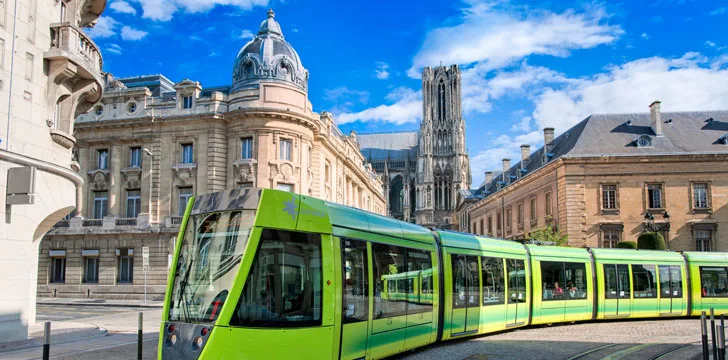
What to discover
Places to visit in Reims
Reims brings several periods of French history into a compact urban centre. Its cathedral recalls royal coronations, Roman structures survive beneath and beside later streets, and twentieth-century sites record both artistic exchange and the end of the Second World War in Europe. The city’s architecture also reflects its place at the heart of Champagne.
The cathedral quarter
Notre-Dame Cathedral was the coronation church for most French kings from the Carolingians to the Bourbons. The Gothic building is about 150 metres long, with a vault rising to nearly 40 metres. Its three-level nave and extensive stained glass create an unusually light interior for a structure of this scale. The sculptural programme includes the Ange au Sourire, or Smiling Angel, associated with the thirteenth-century Champagne school.
Next to the cathedral, the Palais du Tau housed the bishops and archbishops of Reims. It also accommodated kings when they came to the city for their coronation. Following several phases of reconstruction, the palace became a museum devoted to those ceremonies and the objects connected with them. Seeing the two buildings together helps explain how religious ritual, royal lodging and public display operated within the same precinct.
Saint-Rémi and other religious heritage
The Basilique Saint-Rémi was built in the twelfth century to hold the relics of Saint Remi, the bishop who baptised Clovis. A Romanesque nave leads to a Gothic choir arranged over four levels, making the change in architectural language legible within one building.
Close by, the Musée Saint-Rémi occupies the former Benedictine abbey on Rue Simon. Its collections cover the history and archaeology of Reims, with royal objects used at coronations, material connected with Charles X and a substantial group of carved stone. The museum also holds objects associated with the treasury of Notre-Dame.
The Basilique Sainte-Clotilde takes a different form. Built in 1898 in a Byzantine-inspired style, it follows a Greek-cross plan beneath a dome. It honours Clotilde and her role in the conversion of Clovis to Catholicism, and contains an extensive collection of relics held in more than one hundred reliquaries.
Squares and Roman Reims
Place Royale was laid out in the second half of the eighteenth century at the meeting point of routes between Paris and Champagne, and between Flanders and Burgundy. A statue of Louis XV dressed as a Roman emperor occupies the centre. It replaced an earlier image of the king in royal dress that was destroyed during the Revolution.
Place Drouet-d’Erlon is more closely tied to everyday city life. Arcades line the square, with cafés and restaurants beneath them, and the Fontaine Subé rises at its centre under the gilded figure known as La Gloire. Its long open space contrasts with the older remains around Place du Forum.
The Porte de Mars is a substantial Roman arch named after a nearby temple dedicated to the god of war. First conceived as a triumphal monument, it was later absorbed into the city’s defences as a gateway. At Place du Forum, excavations uncovered a Gallo-Roman cryptoporticus. This was one of three underground galleries built around AD 200 and used to store grain, preserving evidence of the practical infrastructure beneath the ancient civic centre.
Art, architecture and wartime history
The Chapelle Foujita, also called the Chapelle Notre-Dame-de-la-Paix, lies near the historic centre. Work began in 1965 under Maurice Clauzier. Its neo-Romanesque shell contains frescoes by Léonard Foujita, the Japanese painter who converted to Catholicism late in his life.
Villa Demoiselle records another artistic transition. Designed by Louis Sorel in the early twentieth century beside the Pommery wine estate, it combines elements of Art Nouveau and Art Deco. Its domestic scale and decorative detail offer a counterpoint to the city’s churches and formal squares.
The Musée de la Reddition preserves the room where the German surrender was signed on 7 May 1945. The room belonged to the Collège Moderne et Technique, where General Eisenhower had established his headquarters. Kept in its 1945 state, it is accompanied by photographs and official documents relating to the signing and the close of the war in Europe.
Keep exploring
More guides from the same area to help you continue your search.