
City guide
Ajaccio
Use the places and landmarks in this guide to plan visits at your own pace.
Read the guide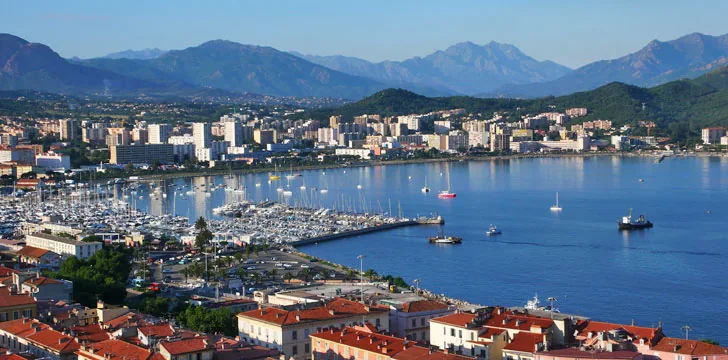
What to discover
Things to see in Ajaccio
Ajaccio’s centre combines Genoese foundations, the Bonaparte family’s legacy and a waterfront setting on the Gulf of Ajaccio. Its streets and squares connect civic buildings, religious architecture and art collections. Beyond the centre, the coast towards the Îles Sanguinaires is shaped by rocky headlands, coves and beaches.
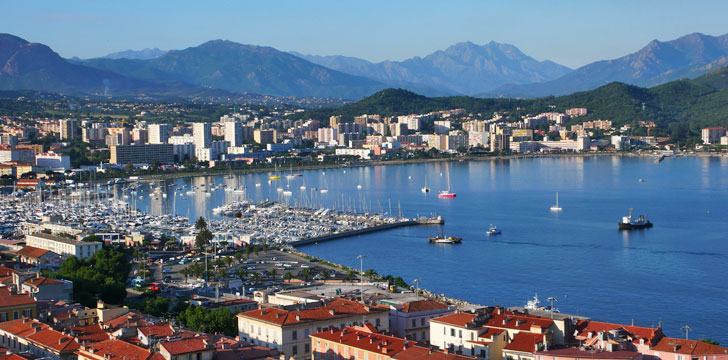
The historic centre and Bonaparte legacy
Place Foch, also known as Place des Palmiers, stands at the heart of the city. The site once marked the beginning of the main road into Genoese Ajaccio, while the square itself was laid out during the Second Empire. Its Fontaine des Quatre Lions supports a statue of Bonaparte as First Consul, dressed in a Roman toga.
The Hôtel de Ville on the square contains the Salon Napoléonien, a museum room devoted to the imperial family. Portraits, busts and sculptures depict figures including Napoleon I, Joseph Bonaparte and Empress Eugénie, beneath a Bohemian crystal chandelier.
Nearby Rue Fesch was originally the main street of Borgu, the suburb outside the Genoese city where local islanders lived. It is now a pedestrian shopping street, distinguished by façades in shades of orange and pink. The Palais Fesch houses the Musée Fesch, named after Cardinal Joseph Fesch, Napoleon’s uncle and its principal benefactor. His collection numbered more than 17,000 works and objects, and his will left around a thousand of them to Ajaccio. Italian painting forms a major part of the museum’s holdings, alongside Corsican art from the nineteenth and twentieth centuries.
The palace’s south wing also contains the Chapelle Impériale, or Chapelle Palatine. Built between 1827 and 1837, it has a crypt for members of the imperial family, a dome painted in grisaille and stained glass combining ecclesiastical and imperial symbols.
Cathedral, citadel and seafront squares
Place du Général de Gaulle links the old city with newer districts and opens towards the gulf. Its equestrian monument shows Napoleon in Roman dress, surrounded by his brothers. A short distance away, Ajaccio Cathedral is dedicated to Santa Maria Assunta, or Notre-Dame-de-l’Assomption. Built from 1577 to 1593, it has a restrained façade and a Baroque interior with six side chapels, paintings and a dome above the crossing.
The citadel occupies a rocky promontory selected to defend the town from attack by sea. Work began when the Genoese founded the city in 1492: the first castle was strengthened and enlarged over later centuries. Its surviving hexagonal form still recalls Ajaccio before it became French.
The Sanguinaires coast
The Route des Sanguinaires follows the shore from Ajaccio towards the island group from which it takes its name. Sandy beaches and small coves lie between the sea and the hills. At its outer end, the rocky Pointe de la Parata carries a Genoese defensive tower dating from 1551, with views across the archipelago and the surrounding maquis.
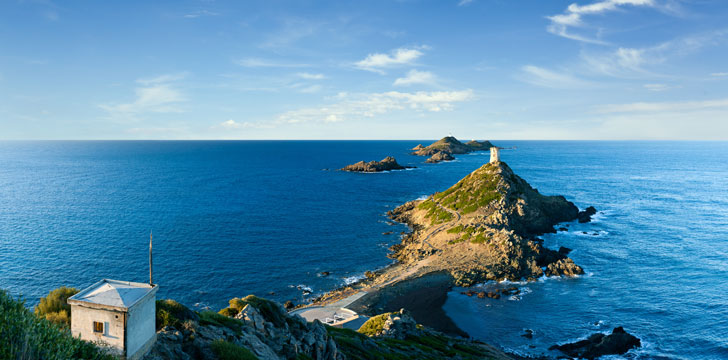
The Îles Sanguinaires consist of four rocky islets. A lighthouse stands at the highest point of Grande Sanguinaire, the principal island. Their exposed red rocks and difficult shoreline have also provided habitat for numerous bird species, and the archipelago is designated as a Natura 2000 site.
West of the city and inland
Capo di Feno beach lies west of Ajaccio. Its clear water and strong waves account for its reputation as a surfing beach. The shore has two sections: Grand Capo and the smaller Petit Capo, which is separated from it by a field.
North of the city, Château de la Punta stands on a hill above the surrounding valley. It was built in the late nineteenth century with stone recovered after the Tuileries Palace was destroyed during the Paris Commune. Each of its four façades follows a different design inspired by a pavilion of the former palace, an architectural contrast with the Corsican hillside.
Keep exploring
More guides from the same area to help you continue your search.