
City guide
Bastia
Use the places and landmarks in this guide to plan visits at your own pace.
Read the guide
What to discover
Things to see in Bastia
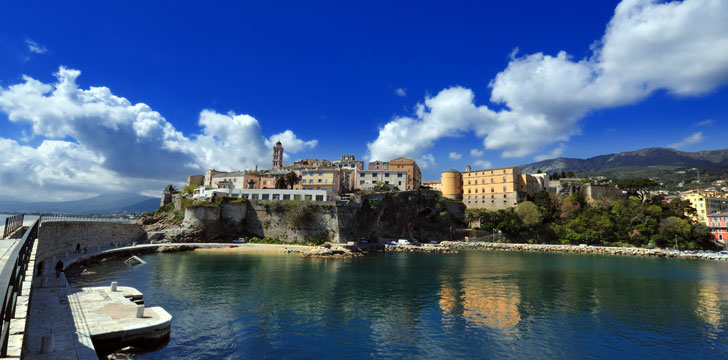
Bastia, on the north-east coast of Corsica, is organised around its old harbour, Genoese citadel and broad Place Saint-Nicolas. Its architecture records the period of Genoese government as well as a strong religious heritage expressed through richly furnished churches and chapels.
The old port and Terra Nova citadel form the historic core. From there, gardens and stepped streets connect the waterfront with the fortified upper town, while beaches and Monte Stello open the visit towards the coast and Cap Corse.
The old port and Jardin Romieu
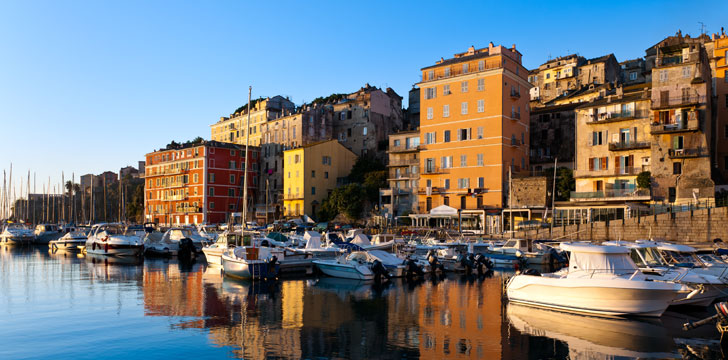
The earliest works at the old port date from 1670, when Corsica was still under Genoese rule. The harbour was enlarged during the nineteenth century: the Genoese pier was extended in 1852, the Dragon jetty followed between 1861 and 1863, and the southern quays were laid out in 1867. Growing traffic eventually prompted construction of a new port in the Saint-Nicolas basin. The old harbour retained its fishing and leisure berths.
Jardin Romieu occupies the slope below the citadel and provides a link between the harbour and the upper town. Created in the 1870s, it is planted with palms, laurels and succulents. Its stairway and stone-paved paths turn the climb into a sequence of garden and harbour views.
The citadel and governors’ palace
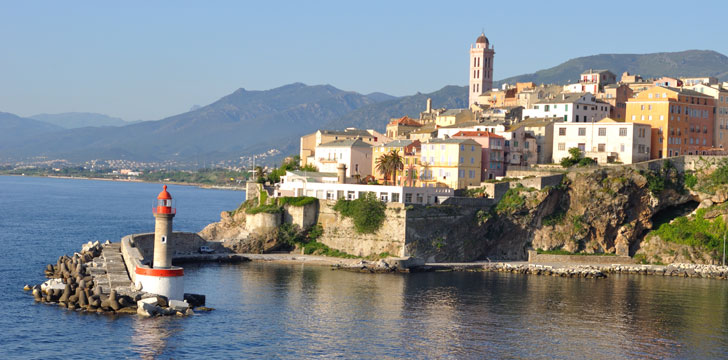
Genoese governor Leonello Lomellini laid the first stones of the citadel in 1380. The walls around Terra Nova were completed in 1480, and the complex was rebuilt and enlarged between 1448 and 1525. Its buildings served as the residence of Corsica’s Genoese governors until the island became part of France in 1768. The site entered military use in 1794, and parts of its northern and southern wings were damaged during the Second World War.
The Palais des Gouverneurs developed from a strategic tower above the port. That tower was called the Bastia and gave the city its name. Repeated alterations turned the castle into a palace during the sixteenth century; a suspended garden was added in the late 1960s, and the building was listed as a Monument historique in 1977.
Churches of the upper town
The Oratoire Sainte-Croix is associated with a confraternity recorded from the early fifteenth century. A local tradition tells how two Bastia fishermen found a black figure of Christ at sea in 1428 and how a chapel was raised at the place where it was later recovered in a tree. The Chapelle du Crucifix des Miracles was listed as a Monument historique in 1931.
The former Cathédrale Sainte-Marie was built on the site of an earlier church towards the end of the fifteenth century and housed Bastia’s bishops between 1600 and 1622. A barrel-vaulted central nave and two side aisles rest on arcades with pilasters. Inside are polychrome marble altars, statues, metalwork and paintings.
Notre-Dame de Monserato, a small chapel dedicated to Saint Pancras, contains a Scala Santa. Pope Pius VII granted this privilege following Bastia’s welcome for 424 priests whom Napoleon had exiled to Corsica in 1811.
Place Saint-Nicolas
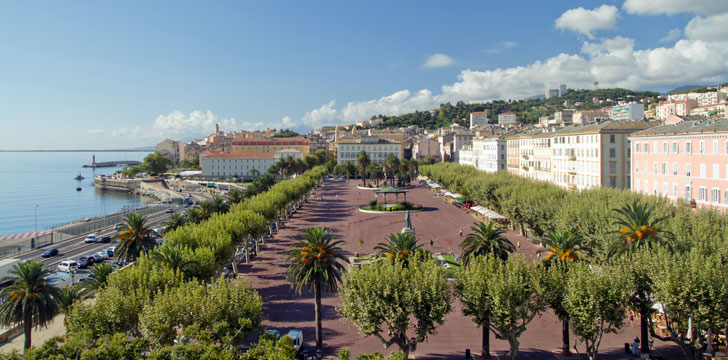
Place Saint-Nicolas is an exceptionally broad waterfront square, approximately 300 metres long and 90 metres wide. It took its name from an eleventh-century chapel demolished when the esplanade was enlarged in the nineteenth century. Among its monuments are a war memorial, a statue of Napoleon dressed as a Roman emperor and a bandstand dating from the end of the nineteenth century. Plane trees, palms and café terraces frame the open space.
Beaches and Monte Stello
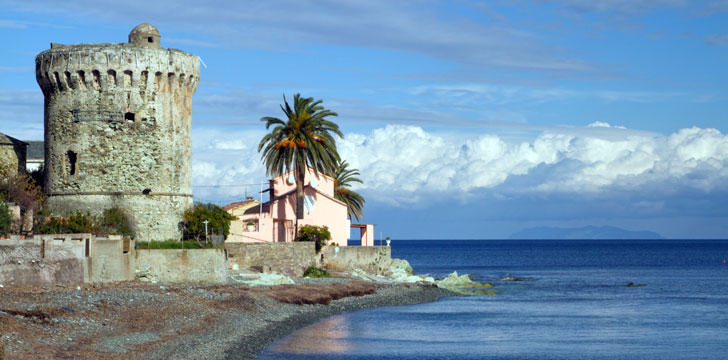
North of Bastia, the Cap Corse beaches of Grigione, Miomo, Lavasina and Erbalunga are pebbled. Arinella and La Marana, south of the city, are sandy, giving the two stretches of coast a visibly different character.
Monte Stello rises to 1,307 metres and is the highest summit on Cap Corse. In clear weather its upper slopes overlook Bastia and the surrounding region. The route is described as roughly three hours up and two and a half hours down, requiring good fitness and proper hiking boots.
Keep exploring
More guides from the same area to help you continue your search.