
Things to See in Besançon
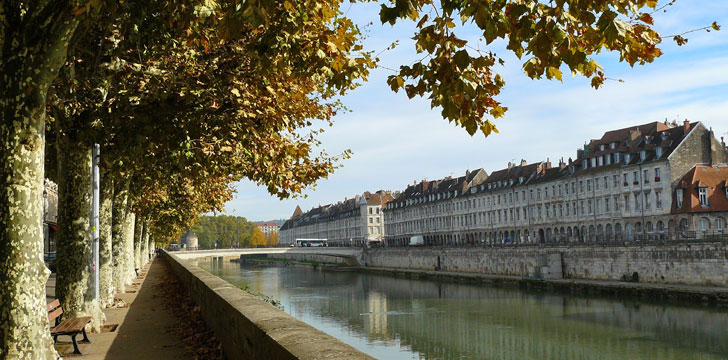
Besançon occupies a pronounced loop of the Doubs, with its old town enclosed by the river and the citadel rising above it from Mont Saint-Étienne. This geography brings the city’s architecture, riverside façades and fortifications into close contact. A visit can move naturally between the quays, pedestrian streets, churches and museums before climbing to Vauban’s defences.
Old Besançon and the river
Pont Battant looks towards the seventeenth-century houses lining the Doubs. Beside it, a statue of Claude-François Jouffroy d’Abans recalls an early figure in steam navigation on the river. Quai Vauban extends on both sides of the bridge, its grey-blue façades and arcades reflected in the water. The ensemble was created in the seventeenth century by the Robelin brothers as a continuous and orderly river frontage.
Place de la Révolution is framed by civic and cultural buildings, including the Musée des Beaux-Arts et d’Archéologie, the conservatoire and the Temple du Saint-Esprit, as well as eighteenth-century town houses. Elsewhere in the centre, the Prefecture occupies the former Palais des Intendants. Two surviving gateways mark still earlier chapters: the Porte Noire is a Roman triumphal arch formerly called the Porte de Mars, while the sixteenth-century Porte Rivotte retains its flanking towers.
The citadel and Vauban fortifications
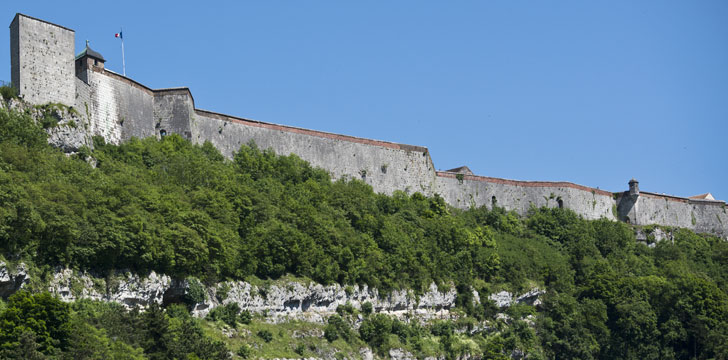
Vauban built the citadel in the seventeenth century on Mont Saint-Étienne, about 118 metres above the city. It has served at different times as a fortress, barracks and prison, and now contains several museums. The citadel forms part of Besançon’s UNESCO-listed fortifications.
The wider defensive system runs for almost 600 metres through an 11-hectare landscaped area. Bastions, curtain walls, sentry boxes and gun towers demonstrate how the site controlled the loop of the Doubs. Sections of rampart measure roughly five to six metres across and rise to between 15 and 20 metres, giving broad views over Besançon and the surrounding country.
Cathedral and churches
Cathédrale Saint-Jean is unusual for its two apses: a Romanesque choir and an elaborately decorated eighteenth-century counter-choir. It has no conventional entrance portal. Inside are an eleventh-century altar, the marble tomb of the canon Ferry Carondelet, Baroque ornament and Fra Bartolomeo’s Virgin and Saints, dated 1512.
The cathedral’s nineteenth-century astronomical clock was made by Auguste-Lucien Vérité of Beauvais. Its 30,000 components drive 11 movements and 57 dials, supplying 122 readings that include the time, calendar, seasons, planetary movements, solstices and tide information for several ports.
Other churches reveal the range of eighteenth-century work in the city. Nicolas Nicole built the Chapelle Notre-Dame du Refuge in 1739; its 26-metre dome contains painted medallions, with Louis XV-period woodwork below. Église Saint-Pierre was designed by Claude-Joseph-Alexandre Bertrand, and its tall bell tower also served the town hall opposite as a belfry. Nicole’s Église Sainte-Madeleine, built from 1746 to 1766, has a regional glazed-tile roof and a carved wooden Jacquemart on its south tower.
Museums and watchmaking
The Musée des Beaux-Arts et d’Archéologie is housed in the former grain market, later extended by Louis Miquel, a pupil of Le Corbusier. Its history dates to 1694. Collections encompass Egyptian antiquities, regional archaeology, faience, tapestries, drawings and painting; named artists include Goya, Giovanni Bellini, Lucas Cranach the Elder, Signac and Bonnard.
Besançon’s watchmaking history is explored at the Musée du Temps in the Palais Granvelle. The directory entry traces the city’s principal watchmaking period from about 1793 to the 1920s. Comtoise clocks and watches sit alongside displays about ways of measuring time, extending from sundials to atomic clocks.