
City guide
Lons-le-Saunier
Use the places and landmarks in this guide to plan visits at your own pace.
Read the guide
What to discover
Things to see in Lons-le-Saunier
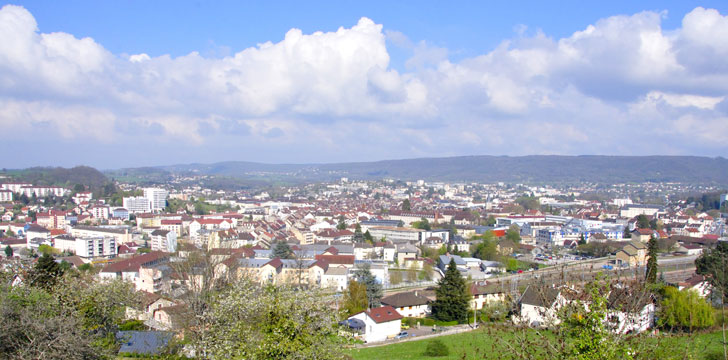
Lons-le-Saunier is a thermal town with a compact centre of arcades, public buildings and open squares. It is also the birthplace of Rouget de Lisle, who composed La Marseillaise.
Most of its principal landmarks cluster around Place de la Liberté and rue du Commerce, while the spa quarter provides a greener counterpoint. Beyond the town, Baume-les-Messieurs and the Cascades du Hérisson introduce the limestone landforms and waterfalls of the surrounding Jura.
Place de la Liberté and the old streets
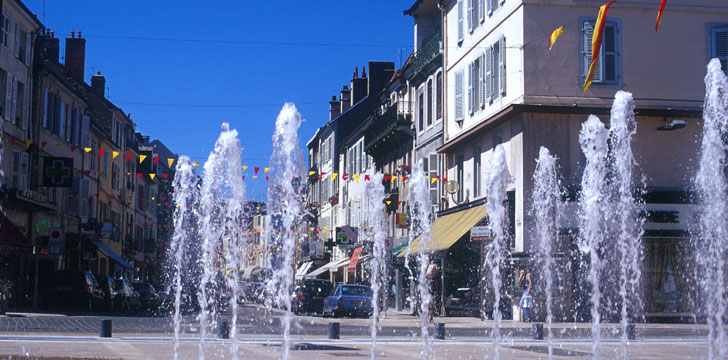
Place de la Liberté forms the civic and commercial heart of the town. The almost rectangular square was created over defensive ditches that had been filled in; fountains and water jets now punctuate the open space, alongside a statue of General Lecourbe.
The Tour de l’Horloge faces the square. This former watchtower and belfry, now one of the town’s defining landmarks, has a Roman-numeral clock that no longer strikes. Its gateway marks the route towards rue des Arcades. Nearby, rue du Commerce was rebuilt in stone after a fire in 1637. Its 146 arcades vary in style, and the street contains Rouget de Lisle’s birthplace, where a small museum is devoted to him.
Civic buildings and collections
The theatre was rebuilt following a fire in 1901. Its rococo interior brings together gilding, stucco, red velvet hangings and painted decoration. Both the building and its decorative ensemble are protected as a Monument historique.
The Musée des Beaux-Arts occupies a wing of the Hôtel de Ville and was founded in 1817. Its holdings range from seventeenth- to nineteenth-century painting to French sculpture of the eighteenth and nineteenth centuries. Brueghel the Younger, Giordano and Gustave Courbet are among the painters represented. The town hall itself was built around 1743 on the site of the Château des Chalon-Arlay; the museum wing was added in the mid-nineteenth century.
Another substantial civic building is the Hôtel-Dieu, constructed between 1735 and 1745 to plans by the Besançon architect J.-P. Galzot. A wrought-iron gate dated 1778 closes its main courtyard. The interior features a grand staircase and an apothecary fitted with carved woodwork, copper and pewter vessels, and faience jars.
The spa quarter
The Thermes de Lédonia stand in a large building characteristic of late nineteenth-century spa architecture. They are set within the seven-hectare Parc des Bains, whose design draws on the landscaped thermal parks of the same period.
Mature trees, ponds, water jets and fountains give the park a distinct identity away from the denser streets of the centre. Together, the spa building and its grounds express the thermal history for which Lons-le-Saunier is known, without requiring a visit to the treatment facilities.
Jura landscapes beyond the town
Baume-les-Messieurs stands beside the Seille at the entrance to the Cirque de Baume. Its houses surround a ninth-century Benedictine abbey built in the Jura Romanesque style and containing a large polychrome altarpiece. Caves lie near the village, while the cliffs and viewpoints of the reculée overlook the cirque.
The Cascades du Hérisson comprise seven waterfalls. The best known are the 65-metre Éventail and the 60-metre Grand Saut. A 7.5-kilometre walking circuit, described as taking about three hours, follows the sequence. At the foot of the falls, the Maison des Cascades, opened in 2003, explains the protected natural site.
Keep exploring
More guides from the same area to help you continue your search.