
City guide
Belfort
Use the places and landmarks in this guide to plan visits at your own pace.
Read the guide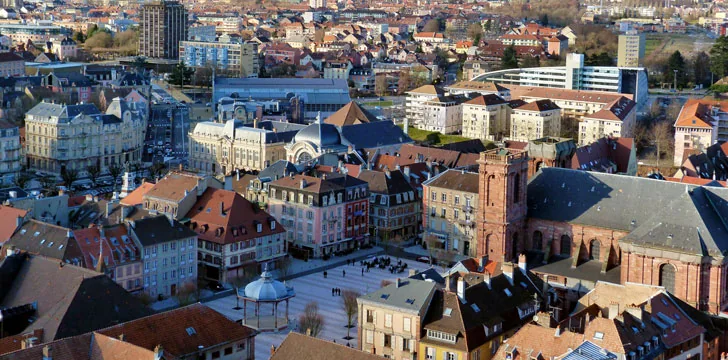
What to discover
Things to see in Belfort
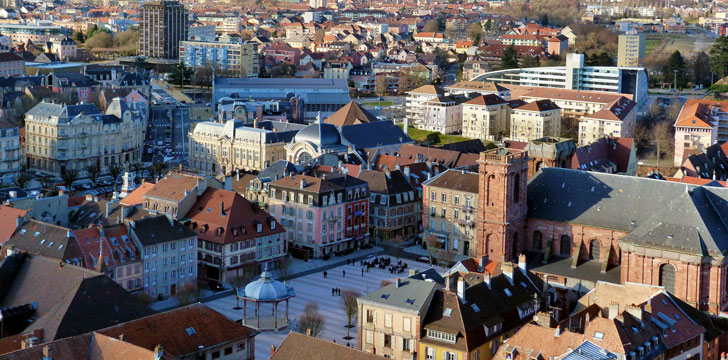
Belfort’s main landmarks are closely tied to its military past. The citadel and walls rise above the old town, while the Lion of Belfort recalls the city’s resistance during the war of 1870. At street level, historic squares, pink-sandstone monuments and surviving fortifications give that history a clear physical shape.
The principal group of sites lies around the citadel and Vieille Ville. The heights of La Miotte, to the north-east, and Fort du Salbert, to the north-west, extend the story beyond the centre.
The Lion, citadel and Porte de Brisach
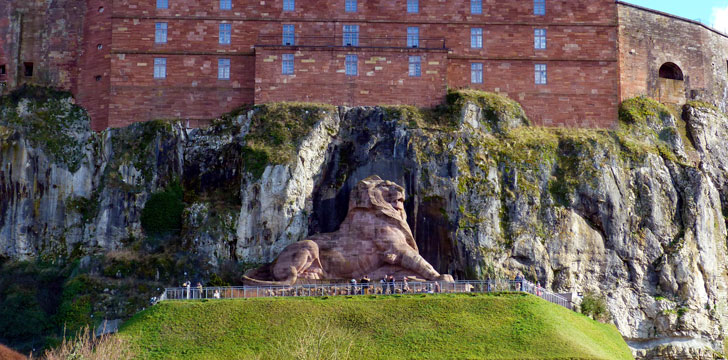
Carved in pink sandstone and set at the foot of the citadel cliff, the Lion of Belfort measures 22 metres long and 11 metres high. It was made between 1875 and 1880 as a memorial to Belfort’s resistance in 1870. The recumbent animal appears alert rather than defeated, an image that has become the city’s principal emblem.
The citadel occupies a strategic site used since the twelfth century and altered repeatedly over the following centuries. In the seventeenth century, Vauban strengthened the complex around the remains of the medieval castle. Its successive enclosures and high walls still convey the scale of the defensive system.
Within the fortifications, the Porte de Brisach leads across a fixed bridge over the former ditches and towards the Vieille Ville. Built in 1687, it carries royal emblems including fleurs-de-lis, a crown and Louis XIV’s motto, Nec pluribus impar.
Streets and squares of the old town
Belfort’s old town combines a medieval quarter dating from the city’s thirteenth-century foundation with the more ordered spaces created under Vauban. Narrow lanes alternate with broader streets, and colourful timber-framed houses sit alongside classical civic and religious buildings.
Place d’Armes gathers several of these elements around its bandstand and the Quand-Même statue. The Hôtel de Ville and Cathédrale Saint-Christophe face the square. Built in the eighteenth century, the cathedral uses the same pink sandstone seen at the Lion; its columned front is framed by two towers.
Place de la Grande Fontaine offers a smaller-scale contrast, with old houses arranged around its fountain. Together with neighbouring Place de l’Étuve, it forms a pedestrian corner of the historic centre.
Art and monuments of remembrance
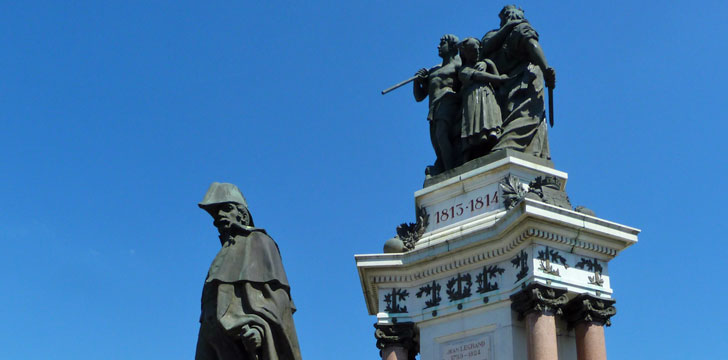
On Place de la République, the Monument des Trois Sièges recalls the sieges of 1813, 1815 and 1870. It honours Jean Legrand, Claude Jacques Lecourbe and Pierre Philippe Denfert-Rochereau. Conceived as a posthumous work by Auguste Bartholdi, the monument was completed by his pupils in 1913.
The Musée des Beaux-Arts is housed in Tour 41, one of the fortified towers. Its collections span the period from the early Middle Ages to the modern era and include allegorical and religious painting, portraits and sculpture.
La Miotte and Fort du Salbert
The Hauts de Belfort occupy La Miotte hill to the north-east. The Tour de la Miotte, a remnant of a medieval castle, was damaged and rebuilt more than once; its latest reconstruction dates from 1947. The elevated ground provides a panorama across Belfort and towards the Vosges.
North-west of the city, Fort du Salbert was constructed between 1874 and 1877 as part of the region’s response to the threat of further Prussian invasion. Its interior was substantially changed after the Second World War to house a radar station, while the outer military structures remain partly covered by vegetation.
Keep exploring
More guides from the same area to help you continue your search.