
City guide
Narbonne
Use the places and landmarks in this guide to plan visits at your own pace.
Read the guide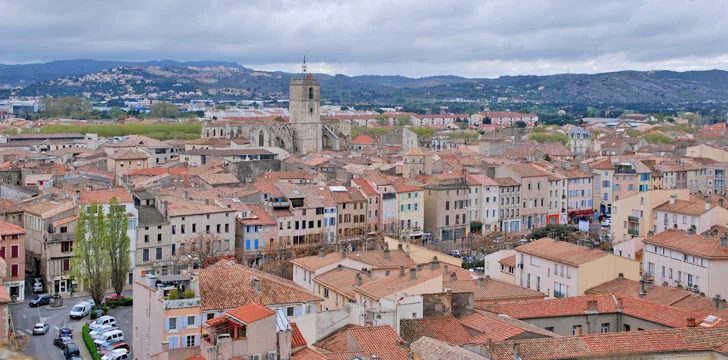
What to discover
Narbonne: Roman Streets and Medieval Monuments
Narbonne’s centre places a Roman road beneath the towers of a later episcopal city. The Romans founded Narbo Martius in 118 BC on the Via Domitia, the first paved road in Gaul and a route between Italy and Spain. A surviving section of its paving can be seen at the foot of the Palais des Archevêques, close to the Canal de la Robine.
The archbishops’ complex
The Palais des Archevêques occupies the heart of Narbonne. Romanesque and Gothic sections sit within the same substantial complex, whose façade includes three square towers built during the thirteenth and fourteenth centuries. The structure formed part of the city’s early defensive walls, with the archbishop’s garden behind it.
Gilles Aycelin became Archbishop of Narbonne in 1290 and had a square keep constructed against the palace. The Donjon Gilles Aycelin rises 41 metres through four levels. Its original external wooden staircase could be removed in an emergency. From the terrace, the view extends across the city towards the coast, the Corbières and the Pyrenees.
Religious buildings had occupied the cathedral site from the fourth century, and Narbonne became an archbishopric in the ninth. Work on the present Cathédrale Saint-Just-et-Saint-Pasteur began in the thirteenth century; Pope Clement IV sent its first stone from Rome. Its radiating Gothic choir reaches almost 41 metres, giving the cathedral a strong vertical presence above the old centre.
A basilica and a bridge
The Basilique Saint-Paul-Serge records a more complicated sequence of destruction and rebuilding. A twelfth-century church replaced an earlier building lost to fire, and later damage led to changes to the nave, transept, aisles and porch. Inside are friezes, paintings, Renaissance door leaves and seventeenth-century Aubusson tapestries. A carved frog in the holy-water stoup near the entrance became associated with the poet Frédéric Mistral.
Pont des Marchands follows the course of the Via Domitia across the Canal de la Robine. It originally had six, perhaps seven, arches, although only one remains visible. Buildings and shops now line the bridge so closely that the pedestrian street gives little immediate sense of the water passing below.
Fontfroide in the Corbières
About 12 kilometres from Narbonne, Fontfroide Abbey occupies a rural site in the Corbières. Founded in the eleventh century by the Cistercian order, the complex includes a refectory, chapel, cloister and courtyard. Its enclosed gardens and rose garden soften the monastic stonework, while surrounding paths open the abbey to the wider Corbières landscape.
From the city to the Mediterranean
Narbonne-Plage lies a few kilometres from the historic centre. A long sandy beach runs beside a seafront boulevard and promenade, with a marina nearby. The resort is physically separate from the old city, but it provides Narbonne’s direct connection with the Mediterranean coast.
The Narbonnaise Regional Nature Park extends across roughly 70,000 hectares of the maritime Corbières and coastal lagoons. Its landscapes include villages, vineyards, olive groves, garrigue, dunes and ponds, with pine woods alternating with wetlands. Marked routes and paths provide the intended way to explore this fragile area. The visible Via Domitia anchors Narbonne’s historic centre, while the canal, abbey and protected coast carry its geography well beyond the cathedral quarter.
Keep exploring
More guides from the same area to help you continue your search.