
Nîmes: Roman heritage and city sights
Nîmes carries several strands of southern French history: Roman, Protestant, Cévennes, Camargue and Languedoc influences all appear in its architecture and public life. The Roman legacy is the clearest starting point, but gardens, churches and civic spaces show how the city continued to change long after antiquity.
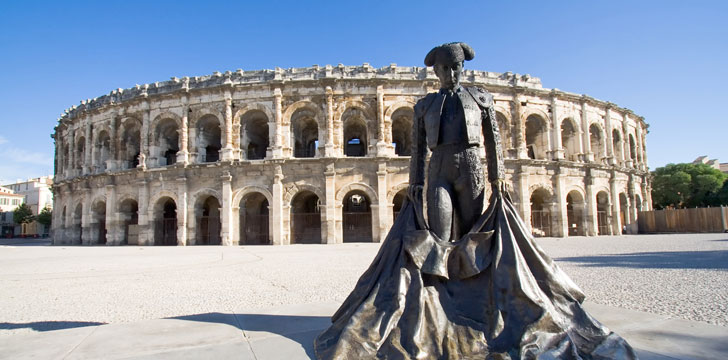
The Roman city
The Arènes de Nîmes were built near the end of the 1st century, probably during the reign of Vespasian. Designed for public entertainment, the amphitheatre could hold almost 25,000 spectators. After the fall of the Roman Empire it became a fortified refuge. Its seating was restored in the 19th century, when the building was adapted for bull events; it has also been used for concerts.
Maison Carrée offers a different view of Roman civic architecture. Six columns support the front of this 1st-century temple, commissioned under Augustus and dedicated to the imperial cult. Its survival owes much to repeated reuse. At various times it served as a church, a consular house, a meeting place during the Revolution, the seat of the Gard prefecture and a museum. The monument underwent a major restoration between 2006 and 2010.
Beyond the centre, the Pont du Gard belonged to the aqueduct that carried water from the Uzès area to Nîmes. Built in the 1st century, the aqueduct appears to have fallen out of use in the 6th. The bridge is the tallest known aqueduct structure from the Roman world. Site work in the early 2000s restricted the bridge to pedestrians and added a museum designed to blend with the surrounding stone.
The spring, gardens and Tour Magne
Jardins de la Fontaine were laid out around a natural spring and rank among Europe’s early public parks. The formal garden uses a central stairway, terraces and paths lined with pines and cedars to frame two ancient remains: the Temple de Diane and Tour Magne. Regional plants and antique statues given by Montpellier are also incorporated into the grounds.
Tour Magne formed part of the ancient city’s high ground and is generally interpreted as a defensive structure and lookout. Imperial alterations increased its height from about 20 metres to more than 35. Victor Hugo later referred to the tower in his poem Guitare. Nearby, the elongated plan of the Temple de Diane has led researchers to question whether the sanctuary had a secular rather than strictly religious function. Its later use as a medieval monastery helped preserve it.
Civic and religious Nîmes
Esplanade Charles-de-Gaulle is bordered by the columned Palais de Justice and café terraces. Avenue Feuchères runs from the esplanade towards the railway station, while a marble work by James Pradier marks the centre of the space. The esplanade was redesigned as a large garden in the early 2000s.
Cathédrale Notre-Dame-et-Saint-Castor records several periods of rebuilding. Its Romanesque predecessor, consecrated by Urban II, was partly destroyed during the Wars of Religion. Classical reconstruction followed, and Henri Antoine Révoil gave the interior a Romanesque-Byzantine treatment in the 19th century. Église Saint-Paul belongs to that same century: Charles Questel directed its construction from 1835 to 1849, and Pierre Boulanger produced its ironwork.
Musée du Vieux Nîmes occupies the former episcopal palace. Founded in the early 20th century, it examines the textile trades that shaped local life in the 18th and 19th centuries, including the serge de Nîmes associated with the name “denim”.