
Things to see in Tulle
Tulle, the departmental capital of Corrèze, developed where the Corrèze and Solane rivers meet. Wooded hills contain a long, narrow town that follows the river for more than four kilometres. Its medieval core, cathedral and distinctive town houses sit alongside collections concerned with local craft and the city’s arms-making past.
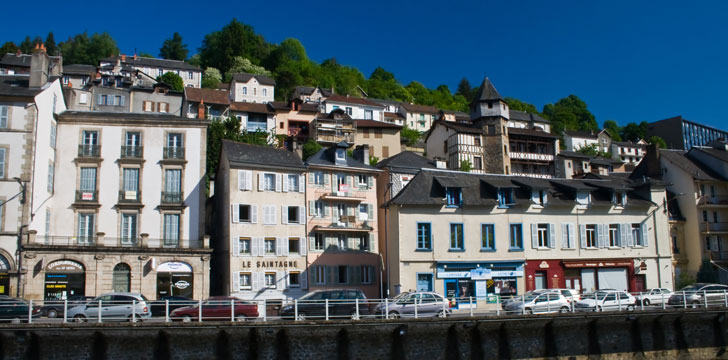
The Enclos and Notre-Dame Cathedral
The Enclos is the name given to old Tulle. In the Middle Ages, houses clustered around the former Abbaye Saint-Martin closely enough to form an enclosure around the settlement. The resulting quarter is a network of narrow lanes and steps, lined with tall 15th- and 16th-century houses. Wooden balconies and projecting upper floors are recurring details.
Cathédrale Notre-Dame rises above this historic area on the site of an earlier Merovingian abbey. Construction began in the 12th century with a Romanesque porch; a Gothic bell tower followed in the 13th century and received its octagonal spire in the 14th. During the French Revolution, the church was converted into an arms factory. A later collapse destroyed its Carolingian ambulatory choir, but the 75-metre tower and a rib-vaulted nave remain.
The interior contains coloured stained glass, a 16th-century statue of Saint John the Baptist and a 12th-century reliquary. The organ dates from 1842. Together, these elements show how the building changed across several periods rather than presenting a single architectural style.
Maison de Loyac
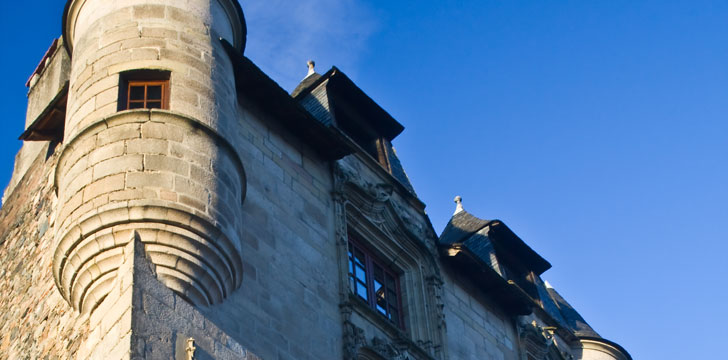
Maison de Loyac dates from the beginning of the 16th century and brings Renaissance ornament to a Flamboyant Gothic structure. Its façade has pediments carved with foliage and unusual animals, including a lion, greyhound, wild boar and mermaid. Columns and curved mouldings frame the doorway, and two small corner turrets complete the elevation. The building is protected as a historic monument.
Craft, performance and industrial history
The cloister museum’s varied collections connect Tulle with the wider history of Corrèze. Displays include regional traditions, faience, embroidered pieces worked in point de Tulle, accordions and weapons made in the city. A section also considers beliefs around witchcraft in the 19th century.
Tulle’s theatre was conceived with fire safety in mind. It was built to plans by Joseph Auberty and Anatole de Baudot, whose design used a reinforced-concrete structure. The city’s industrial history is treated more directly at the Musée des Armes, housed in premises formerly occupied by the military manufacturer Giat Industrie. Its collections range from sabres and bayonet rifles to carbines and machine guns, accompanied by an account of the site itself.