
Things to see in Limoges
Limoges lies beside the Vienne on the first foothills of the Massif Central. The city is closely associated with porcelain, but its historic fabric also includes a long-built Gothic cathedral, medieval streets and a stone bridge across the river. Museums devoted to ceramics, enamels and local history give useful context to the buildings.
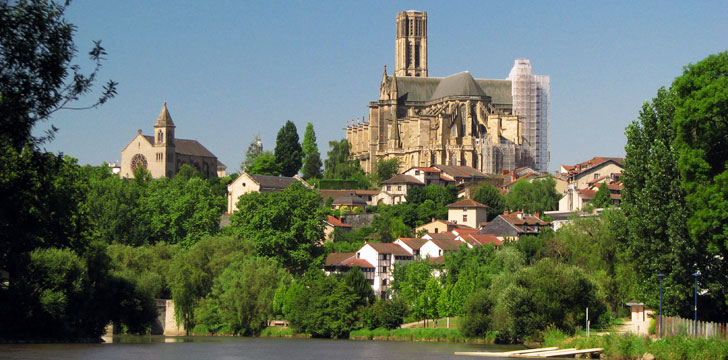
The cathedral quarter and the Vienne
Work on Cathédrale Saint-Étienne began in the 13th century and was not completed until the 19th. Its earliest part is the choir, built in the Rayonnant Gothic style; joining the bell tower to the nave formed the final stage of the project. Inside are a rood screen and the tomb of Jean de Langeac, the bishop who commissioned it.
The former episcopal precinct continues into the Jardin de l’Évêché, five hectares of gardens overlooking the Vienne. The grounds are divided between a formal French garden, a public garden with pools and trees, and a botanical garden organised into systematic, regional and themed areas. Below this high ground, the 13th-century Pont Saint-Étienne crosses the river for 120 metres. The stone bridge once formed part of the city’s defences and was protected by towers and drawbridges at either end.
Landmarks in the city centre
Gare des Bénédictins is identified by its dome, stained glass and a campanile rising to almost 70 metres. Academic figures decorate the exterior, while a large clock face crowns the tower. The Hôtel de Ville belongs to a different architectural chapter: Albert Leclerc designed this late-19th-century neo-Renaissance building. Its façade combines a clock and the city’s arms with allegorical figures representing enamelling and goldsmithing.
For an older, more intimate setting, the 17th-century Cour du Temple lies between rue du Temple and rue du Consulat. Half-timbering and colonnades frame the courtyard, and neighbouring town houses are connected by open galleries and Renaissance staircases. The nearby Chapelle Saint-Aurélien holds the relics of Limoges’ second bishop. Owned by the Saint-Aurélien brotherhood, which developed from the butchers’ guild, it contains sculpture, a 15th-century figure of Saint Catherine and an altarpiece centred on the Transfiguration.
Porcelain, enamel and city collections
The Adrien Dubouché porcelain museum takes its name from a patron who also directed the city’s school of decorative art. Its ceramics, faience and porcelain trace the craft that drove much of Limoges’ 19th-century prosperity. The city had sixteen porcelain manufactories in 1827 and nearly thirty three decades later; during the second half of the century, Limoges porcelain also entered the American market.
Beside the cathedral, the Musée de l’Évêché occupies an 18th-century U-shaped bishop’s palace with an orangery and two pavilions. The collections cover the history of Limoges alongside paintings and drawings. Medieval enamels are a particular strength, while Egyptian funerary pieces reflect the collecting history of a regional industrialist who worked in Egypt.
A medieval site beyond the centre
Château de Châlucet adds a fortified landscape to the city’s architectural story. The site originated in the 12th century and has two defensive sections, traditionally known as Haut and Bas Châlucet. The upper fortress was rebuilt in the 13th century, leaving a layered medieval complex rather than a single-period castle.