
Things to see in Foix
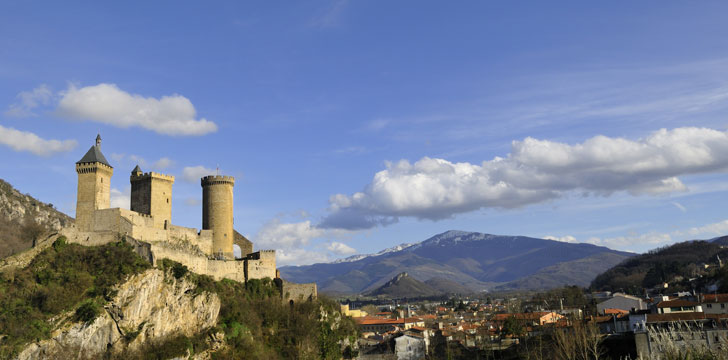
Foix sits at the foot of the Pyrenees, where a compact medieval centre gathers beneath the three towers of the Château des Comtes de Foix. One of France’s smallest departmental capitals, it combines streets shaped by its abbey and castle with views towards the Ariège valley and surrounding mountains.
The old town
The historic quarter grew first around the Abbey of Saint-Volusien in the 11th century and then around the castle. Its narrow lanes still contain timber-framed houses, carved wooden doors and small passages linking buildings above street level. Rue des Grands Ducs is especially associated with these overhead links, while Rue de la Faurie and Rue Labistour offer further examples of the old town’s domestic architecture.
South of these lanes, the Allées de Vilotte mark an area that stood beyond the medieval enclosure. After the walls were removed in the 13th century, it was laid out as a promenade with plane trees and fountains. The name Vilotte means ‘little town’, a reminder of the district’s position outside the earlier settlement.
Castle, museum and church
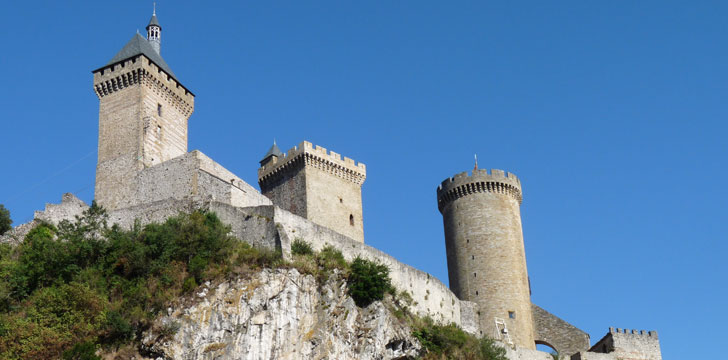
The Château des Comtes de Foix began as a military stronghold, with origins in the 10th century, before becoming the residence of the Counts of Foix. Gaston Phébus is the best-known figure connected with it. The fortress controlled access to the upper Ariège valley and was regarded as exceptionally difficult to take during the Middle Ages.
Three towers survive: the oldest is a square tower with a slate roof, accompanied by a central tower and a later round tower in the Gothic style. Inside are vaulted rooms dating from the 14th and 15th centuries. The terrace provides a broad outlook across the valley and towards the mountains.
The departmental museum within the castle places the fortress in a wider Ariège context. Its collections cover prehistoric activity in the department’s caves and palaeontology, followed by Gallo-Roman and medieval archaeology. Displays of hunting and military weapons recall the building’s defensive purpose, while later objects trace the town’s history through the 16th, 17th and 18th centuries.
Église Saint-Volusien was built in the 12th century to house relics of Saint Volusien, an archbishop of Tours who died near Foix. Romanesque details survive in its portal and capitals. The raised nave and choir are Gothic, and the interior also contains sculpture and a Renaissance-style altar.
Views and heritage near Foix
On the western side of the Foix cluse, the Croix de Saint-Sauveur overlooks the town, Pont Vieux, the Allées de Vilotte and the abbey cloister. The viewpoint also opens onto the landforms and peaks beyond the town.
The Forges de Pyrène interpret working life in Ariège through tools, reconstructed workshops and presentations devoted to more than 120 trades, many of which have disappeared. A tilt-hammer forge forms part of the site. Another nearby attraction is the underground River Labouiche, discovered in 1908 by Dr Jules Dunac. Its boat route runs about 70 metres below ground through limestone galleries containing stalactites, stalagmites and the Salette waterfall.