
City guide
Toulouse
Use the places and landmarks in this guide to plan visits at your own pace.
Read the guide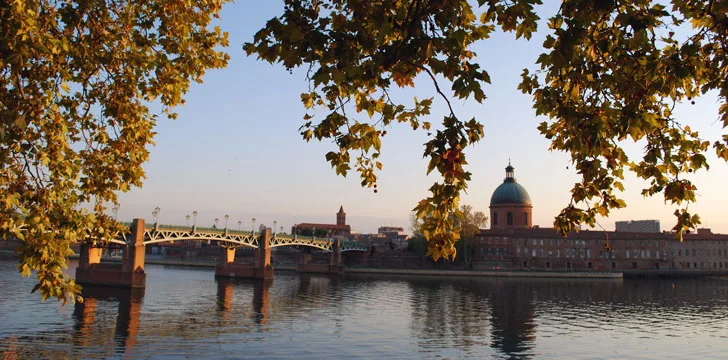
What to discover
Things to see in Toulouse
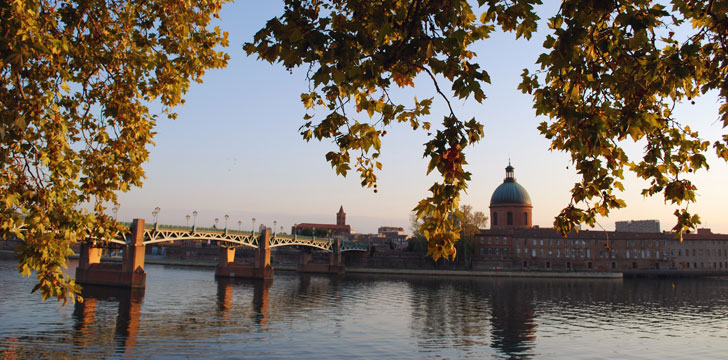
Toulouse is shaped by brick, the Garonne and a long civic history. The former Visigothic capital later became the historic capital of Languedoc, while its early university, trade and industry gave the city a wider outlook. Its familiar name, the “Pink City”, refers to the material that colours much of its architecture. Another name, the “City of Violets”, recalls a trade in flowers used for sweets and syrups.
Around the Capitole and the Garonne
The Capitole brings Toulouse’s municipal and theatrical life into one building. It faces the broad Place du Capitole, where a twelve-point Occitan cross marks the paving. Municipal government was established on this site by the Capitouls in the twelfth century. The classical limestone-and-brick façade associated with Guillaume Cammas is arranged over two storeys, with forty-one windows and wrought-iron balconies.
At the river, Pont-Neuf is the oldest surviving bridge across the Garonne in Toulouse. Begun on the initiative of François I, it links the Place Esquirol side of the centre with Cours Dillon. Its seven unequal arches and open piers reflect the care taken to withstand exceptional floods; granite foundation blocks were set beneath the riverbed.
Romanesque and Gothic Toulouse
The Basilica of Saint-Sernin was built in the eleventh century around the relics of the martyred bishop Saint Saturnin. Its scale and more than 250 carved capitals make it a major example of southern Romanesque architecture. During the Middle Ages it became an important pilgrimage church for travellers heading towards Santiago de Compostela, and it housed a community of canons until the Revolution.
Saint-Étienne Cathedral is less stylistically uniform. Work began in the thirteenth century, although traces of an earlier building reach back to the late eleventh century. Romanesque fabric, a Raymondine nave and a Gothic choir meet on an unusual broken axis because the choir is twice the width of the nave. The church also retains original stained glass, including examples dating to the fourteenth century.
The brick Church of the Jacobins belongs to the Languedoc Gothic tradition. It forms part of a complex with a convent and cloister built for the Dominican Order of Preachers. The church contains the remains of Thomas Aquinas and, before the Revolution, the complex was the seat of the University of Toulouse.
Art, gardens and space
Founded in 1793, the Musée des Augustins is the city’s fine-arts museum. Its sculpture holdings include a substantial group of twelfth-century Romanesque work and regional Gothic pieces from the fourteenth and fifteenth centuries. Later sculpture represented in the collection includes work by Camille Claudel and Auguste Rodin.
Renaissance architecture is represented by the Hôtel d’Assézat, designed by the Toulouse architect Nicolas Bachelier around a square courtyard. The building houses a collection of European art with works attributed in the directory entry to artists including Canaletto, Degas, Toulouse-Lautrec, Van Dyck, Monet, Modigliani and Picasso. It also accommodates several learned societies.
Two sites extend the picture beyond the historic centre. The Japanese Garden, created in 1981, covers about 7,000 square metres and uses East Asian plants, screens of vegetation and low hills to separate its contemplative space from the surrounding park. The Cité de l’Espace approaches space exploration through full-scale models of Ariane rockets and Soyuz modules, alongside a planetarium and three-dimensional film presentations.
Keep exploring
More guides from the same area to help you continue your search.