
Things to see in Cahors
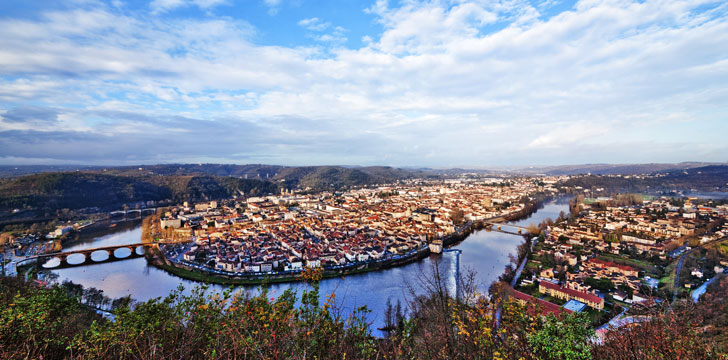
Cahors, the prefecture of the Lot and former capital of Quercy, occupies a river setting enclosed by hills. The city’s streets bring together medieval buildings and traces of a much older past. Its fortified bridge, cathedral, waterworks and gardens each explain part of the relationship between Cahors, its defences and the Lot.
The river crossing
West of the city centre, Pont Valentré crosses the Lot on six stone arches. Three fortified towers once controlled access across the bridge. It dates from the fourteenth century and was built during the period of conflict between France and England. The crossing altered the city’s commercial geography by opening an east–west route where trade had previously followed a north–south axis. It also lies on a route to Santiago de Compostela and on the GR36 long-distance path.
About fifty metres away, the Cabazat records a different use of the river. This pumping station was constructed in the mid-nineteenth century and enlarged late in the 1860s. Water from the Fontaine des Chartreux was lifted towards reservoirs cut beneath the hill, then supplied to the city’s drinking-water system. The station remained in operation until the early 1970s, when electric pumping replaced it.
Cathedral and old town
Saint-Étienne Cathedral is predominantly Romanesque, with later Gothic work in its cloister. The fortified character of the building reflects a period when local bishops also held secular authority as counts and barons. Monumental domes, described as Byzantine in influence, rise more than thirty metres. The sixteenth-century cloister was built under Bishop Antoine de Luzech. The cathedral also preserves the relic known as the Holy Coif, traditionally associated with Christ and said to have been brought from the Holy Land by crusaders in the early twelfth century.
The old town is a close network of lanes, medieval houses and defensive remains. The Barbican guarded one of the entrances to Cahors. The tower of the Palais Duèze rises to almost thirty-five metres, while the Daurade quarter contains the overhanging storeys of Maison Hérétié and the pointed windows of Maison Borneau. These details reveal the variety of domestic as well as military architecture within the historic centre.
Place Gambetta provides a later civic focus. A large statue commemorates Léon Gambetta, who studied in Cahors and gave his name to the school behind the square. Gambetta was a republican lawyer and an opponent of Napoleon III. The surrounding restaurants and terraces reflect the square’s place at the centre of the city.
Collections, gardens and a wider view
The Musée Henri-Martin occupies the former episcopal palace. Its archaeological material covers periods between prehistory and the Middle Ages, while its ethnographic holdings concern societies in Africa, Asia and Oceania. The museum also holds documents connected with Gambetta. These collections add social and material history to the architecture encountered in the surrounding streets.
Mont Saint-Cyr overlooks the city and the banks of the Lot. Seen from above, the compact shape of Cahors and its position among river and hills become clear. Within the city, the Jardins secrets circuit offers a ground-level counterpart. Created as a municipal initiative in 2002, the small gardens use floral composition to draw attention to historic spaces and provide places for local planting ideas.