
City guide
Montauban
Use the places and landmarks in this guide to plan visits at your own pace.
Read the guide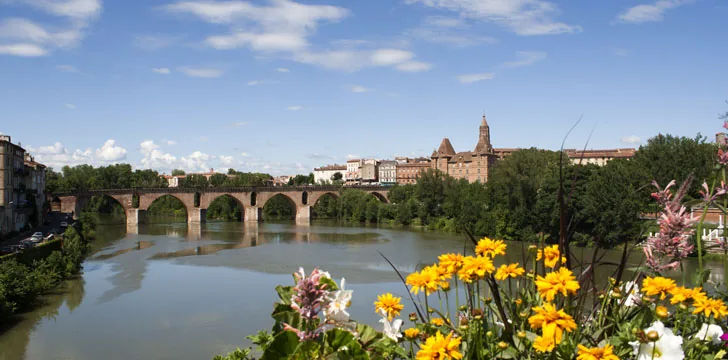
What to discover
Things to see in Montauban
Montauban is a red-brick bastide on the Tarn and the administrative centre of Tarn-et-Garonne. Founded in the 12th century by the Count of Toulouse, it retains an old town of arcaded squares, private mansions, churches and museums shaped by several distinct periods.
The old town and Place Nationale
The historic centre is best understood on foot. Streets lined with brick façades from the 17th and 18th centuries lead past town houses such as Hôtel Lefranc de Pompignan, then towards the river and Pont Vieux. The consistent materials give the centre a visual continuity, while the bridge and left-bank quays provide a wider view of the city beside the Tarn.
Place Nationale is the architectural core of Montauban. Rebuilt in the 17th century after a fire, it follows the footprint of earlier fortifications and preserves the form of an enclosed medieval square. Two rows of vaulted arcades run around it. The outer gallery was intended for merchants’ stalls; the inner gallery gave pedestrians a sheltered passage. Ochre façades above the arcades complete the square’s ordered composition.
Cathedral and church architecture
Cathédrale Notre-Dame-de-l’Assomption differs sharply from the surrounding brick buildings. Louis XIV ordered its construction in stone during the 17th century as an assertion of Catholic authority in a city with a Protestant tradition. The classical west front has two square towers and a peristyle bearing statues of the four Evangelists. Inside are 18th-century wall paintings and Jean-Auguste-Dominique Ingres’s Le Vœu de Louis XIII.
Église Saint-Jacques has older origins. This 13th-century Romanesque church is marked by an octagonal brick bell tower. Its Gothic vault and apse were added after the Hundred Years’ War, following partial destruction of the earlier building. In the second chapel, an altar and altarpiece are the work of Joseph Ingres, father of the painter.
Ingres, Bourdelle and local history
The museum devoted to Ingres occupies a 17th-century building that served first as the bishops’ palace and later as the town hall. Its holdings include drawings, academic studies, sketches and portraits by the Montauban-born artist. Paintings formerly owned by the city’s bishops broaden the display from the Renaissance to the modern period. A ground-floor room focuses on sculptor Antoine Bourdelle and includes a group of busts and Héraklès archer.
The former Jesuit college adds another layer to the civic centre. The Jesuits acquired a town house here in 1676 and developed a college and chapel around two courtyards that had once been gardens. During the French Revolution the complex became a cannon foundry, before returning to educational use until 1961. Its former chapel became Église Saint-Joseph.
A separate natural-history collection has occupied the former Cour des Aides palace since 1852. The zoological displays cover mammals, reptiles, fish and birds, alongside mineralogy and palaeontology. Fossils from the Phosphorites du Quercy and a fragment of the Orgueil meteorite connect the collection to south-western France.
Pont Vieux
Pont Vieux was built at the beginning of the 14th century by architects Étienne de Ferrières and Mathieu de Verdun, at the request of Philip the Fair. The pink-brick bridge extends for 205 metres across the Tarn. Seven pointed arches rest on piers fitted with cutwaters, giving the structure the robust profile seen from the old town and the riverbanks.
Keep exploring
More guides from the same area to help you continue your search.