
Things to see in Lille
Lille’s architecture records a long and complicated history. Before becoming French, the city belonged at different times to the County of Flanders, the Burgundian states, the Holy Roman Empire and the Spanish Netherlands. Its later development as a major 19th-century industrial centre followed an earlier period of mercantile wealth.
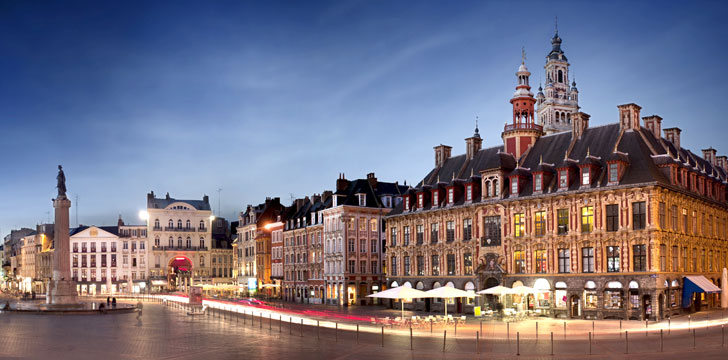
Grand Place and the commercial city
Grand Place lies between Lille’s pedestrian district and the old town. The square contains the column of the Goddess, encircled by fountains, as well as the Vieille Bourse and the former Grand’Garde. It remains the clearest starting point for reading the city’s commercial past through its public buildings.
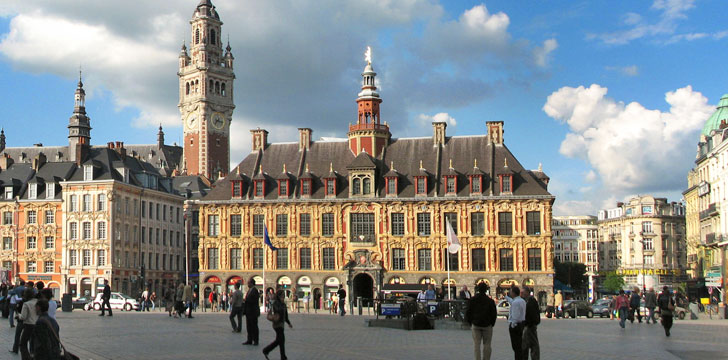
Built in the 17th century, the Vieille Bourse uses a Flemish-inspired Mannerist style. What appears from the square to be one elaborate monument is a group of 24 matching houses enclosing a courtyard. It functioned as a trading exchange and later housed the city’s chamber of commerce before that institution moved to its own premises.
That later Chamber of Commerce and Industry building stands on Place du Théâtre. Louis-Marie Cordonnier designed it in a neo-Flemish style at the beginning of the 20th century; its belfry rises more than 70 metres above the neighbouring opera house. The façade combines scrollwork and plant ornament with a blend of Flemish roots and French influence.
Lille’s opera was also built in the early 20th century, replacing a theatre destroyed by fire in 1903. Its neoclassical façade takes inspiration from the Palais Garnier in Paris, while the auditorium follows the Italian horseshoe model.
Burgundian remains and churches
Palais Rihour is the surviving part of a 15th-century palace built by the Valois dukes of Burgundy. Fires destroyed much of the original four-wing complex, but the chapel and guardroom retain Gothic rib vaulting. These rooms give a rare physical link to Lille’s Burgundian period.
In Vieux-Lille, the neo-Gothic Cathédrale Notre-Dame-de-la-Treille was begun in the second half of the 19th century. Its restrained modern façade contrasts with the historicist interior. The church takes its name from a venerated statue of the Virgin and acquired cathedral status when the Diocese of Lille was created.
Église Saint-Maurice developed over a much longer period, from the 14th to the 19th century. Its aisles share a similar height and width, a feature associated with Brabantine Gothic hall churches. The interior includes biblical paintings by the Bruges-born artist Jakob van Oost, who lived in Lille during the latter half of the 17th century.
Art, civic architecture and the citadel
The Palais des Beaux-Arts brings together Flemish and French painting, sculpture, Renaissance decorative arts and a substantial numismatic collection. It provides an art-historical counterpart to the architecture encountered in the surrounding streets.
Porte de Paris, shaped as a triumphal arch, commemorates the victories of Louis XIV. Sculpted figures of Fame and Victory crown this former element of the city’s defences. Nearby, the present Hôtel de Ville was commissioned after an accidental fire destroyed its predecessor. Designed by Émile Dubuisson and begun in 1924, it combines concrete, brick, Béthisy stone and ceramics beneath a belfry more than 100 metres high.
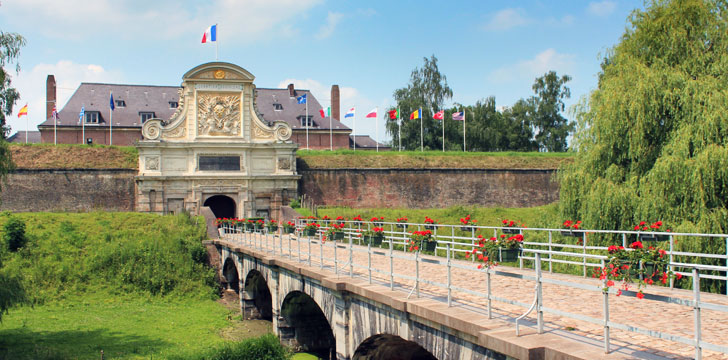
Vauban’s citadel closes the historic sequence. Its scale and carefully planned fortifications made it an important model for his later citadels, and continued military use helped preserve the structure. The surrounding park, shaped in part by the earthworks, covers about 60 hectares and forms Lille’s principal green space.