
Things to see in Calais
Calais occupies a strategic position facing England and the routes towards northern Europe. Centuries of conflict, cross-Channel contact and industrial development have left a city of civic monuments, coastal defences and museums devoted to lace and wartime history.
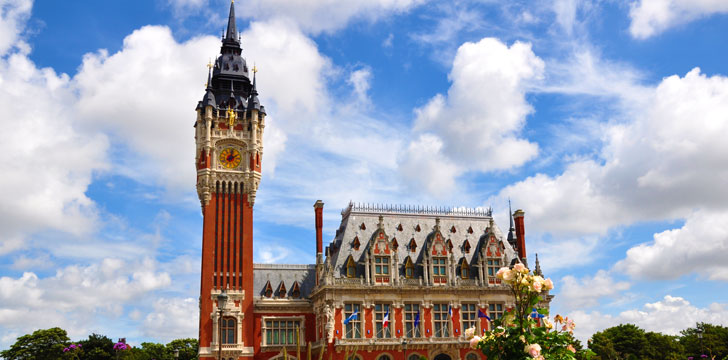
Town hall, Rodin and the theatre
Calais Town Hall and its 75-metre belfry were inaugurated in 1925. Built in a neo-Flemish style, the ensemble is included in UNESCO’s World Heritage listing of belfries. Its tall profile forms the backdrop to one of the city’s best-known works of public art.
Rodin’s bronze group The Burghers of Calais stands opposite the town hall. Six figures, burdened and linked by a rope, represent the citizens who surrendered the keys of Calais to Edward III of England in 1347. The episode began more than two centuries of English rule, and Rodin’s treatment of it became a symbol of the city.
On Place Albert 1er, the theatre dates from 1902 and was inaugurated by French president Émile Loubet. Four statues on its columned façade represent comedy, dance, music and poetry. The main auditorium follows the semicircular form of a Renaissance theatre, with stalls and three balcony levels.
Church, lighthouse and museums
Église Notre-Dame is the oldest monument included among the city’s historic landmarks. Built during the 15th and 16th centuries, partly by Flemish workers allied with the English, it has a central tower that reflects English architectural influence. An 18th-century chapel and 19th-century neo-Gothic decoration add to its mixture of styles. Charles de Gaulle and Calais-born Yvonne Vendroux married here in 1921.
The Calais lighthouse stands unusually close to the town centre. Completed in 1848 to replace the signal fire on the medieval Tour du Guet, it was electrified in 1883 and later automated. Its white shaft and black lantern are reached by a staircase of 271 steps.
Calais’s industrial heritage is represented by the Cité internationale de la dentelle. Opened in 2009, the museum occupies a 19th-century lace factory extended with a glass-and-steel building. Five display areas, covering about 2,500 square metres, explain the history and techniques of lace and their place in the city’s past.
Musée Mémoire 1939–1945 occupies a former German naval command and communications post in Parc Saint-Pierre, facing the town hall. Its setting connects the displays directly to the Second World War and the period’s impact on Calais.
Fortifications and the coast
The city’s defences survive in several forms. Work on the citadel began in 1564 to protect Calais from renewed attack; Vauban later strengthened and reorganised it. Fort Nieulay, first built near the River Hames in 1525, controlled locks that could flood the surrounding Calaisis. Vauban rebuilt the fort in 1677. Fort Risban guarded the port and required extensive repair after an explosion in 1800.
Tour du Guet is older than the English capture of 1347, although its exact construction date is unknown. It was adapted as a lighthouse in 1818, when a rotating oil lamp was installed at the top of the 38-metre tower. Despite repeated rebuilding, it survived the destruction inflicted on Calais during both world wars.
Beyond the fortifications, the seafront provides a long esplanade beside a broad sandy beach. About 10 kilometres from Calais, at Escalles, Cap Blanc-Nez rises to 134 metres within the Parc naturel régional des Caps et Marais d’Opale. Its chalk and marl cliffs overlook the Channel; in clear conditions, the English coast can be seen from the top, while the shore below exposes fossilised Quaternary deposits.