
What to see in Angers
Angers, the historic capital of Anjou and departmental capital of Maine-et-Loire, carries its past into the present-day city centre. The Plantagenet story, the dukes of Anjou and a strong tradition of tapestry and sculpture can all be traced through its castle, churches, old houses and museums.
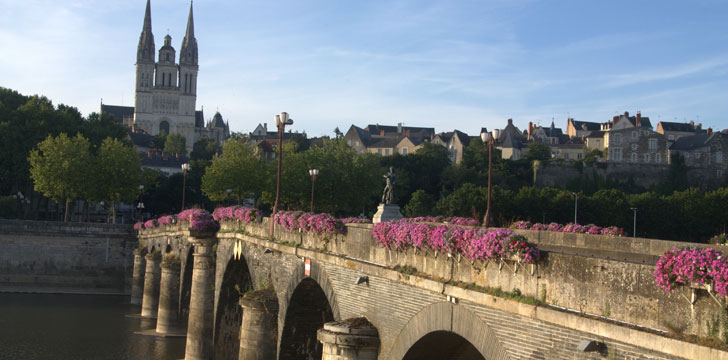
The château and the Apocalypse Tapestry
The Château d’Angers occupies a schist outcrop on the left bank. Built in stages between the thirteenth and sixteenth centuries, it served as a residence of the dukes of Anjou. An order to destroy it at the end of the Wars of Religion was only partly carried out: sections of the towers were removed, but the fortress survived later uses as a prison and ammunition store.
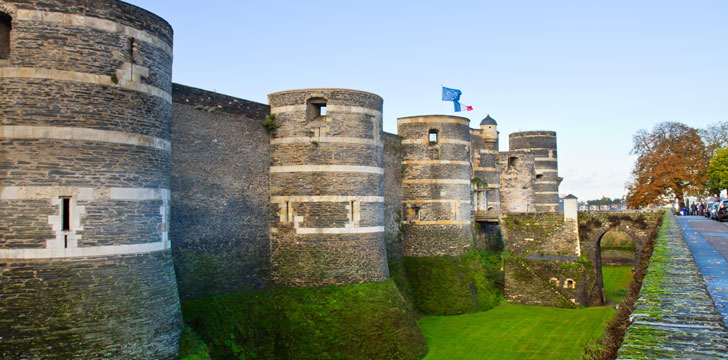
The castle also holds the city’s best-known work of medieval art. The Apocalypse Tapestry illustrates the Book of Revelation and was commissioned for Louis I of Anjou from the merchant Nicolas Bataille. Its six original sections each exceeded 20 metres; the surviving display runs to roughly 100 metres of an original 140. Scale alone does not explain its interest: the sequence is also a detailed example of late-medieval narrative weaving.
Churches and the historic centre
Saint-Maurice Cathedral was built principally in the twelfth and thirteenth centuries. Its lower nave walls retain Romanesque work, while ribbed vaults and columns above introduce the Angevin Gothic style. The two spires were added in the sixteenth century and rise above the centre of Angers.
The Collégiale Saint-Martin has followed a less conventional path. It became a collegiate church in the eleventh century, was sold during the Revolution and subsequently used for timber storage and tobacco administration. Its crypt, statuary and sacristy museum record the site’s long history; the sculpture includes a polychrome stone Virgin and Child.
Place Sainte-Croix lies close to the cathedral and Place Freppel. At its edge stands the Maison d’Adam, a late-fifteenth-century timber-framed house with densely carved beams. Its corner turret bears a tree-of-life motif; figures of Adam and Eve that once formed part of the carving were destroyed during the Revolution.
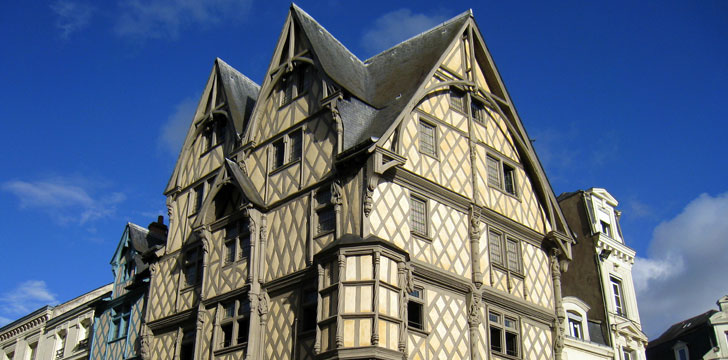
The 54-metre Tour Saint-Aubin is another prominent survivor. Its arrow slits and wells point to an early defensive role. After the Revolution it was used to manufacture lead shot, and its belfry, roof and bell turret were removed during the nineteenth century.
Art, tapestry and archaeology
The Musée des Beaux-Arts occupies the Logis des Barrault on Place Saint-Éloi. Paintings, sculpture, drawings and decorative arts share the galleries with material on the history of Angers, including carved woodwork and archaeological fragments.
At the former Hôpital Saint-Jean, the Musée Jean-Lurçat centres on ten tapestries bequeathed by Lurçat. Conceived as a modern counterpart to the Apocalypse cycle, the group connects Angers’ medieval collection with twentieth-century tapestry. The nearby former orphanage extends that account through works associated with more recent history.
The Renaissance Hôtel de Pincé houses collections from Greek, Roman, Etruscan and Egyptian antiquity alongside Chinese and Japanese art. The Galerie David d’Angers, beside the fine-arts museum, takes a different approach, presenting preparatory work for bronze and marble sculpture, portrait busts and studies for the pediment of the Panthéon in Paris.
A garden shaped over two centuries
Angers’ Jardin des Plantes began in the eighteenth century and expanded during the nineteenth as a public place for walking. Édouard André redesigned it in the early twentieth century. Its layout and specimen trees, including Afghan oaks and Siberian elms, provide a quieter counterpoint to the closely built historic centre.