
What to see in Le Mans
Le Mans has two strong identities. Its historic centre preserves Roman defences, medieval religious buildings and close links with the Plantagenet dynasty, while the city’s name is also inseparable from endurance motor racing. The old quarter is compact enough to reveal several periods of this history within a relatively small area.
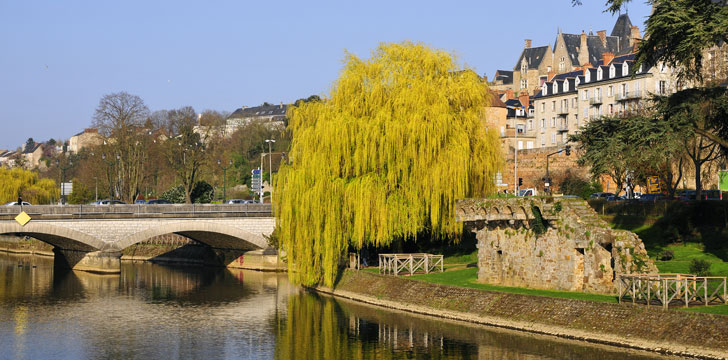
The Cité Plantagenêt and Roman Le Mans
The Cité Plantagenêt, commonly called Vieux Mans, is the natural starting point for the city’s older monuments. Its lanes run between religious buildings, former royal sites, Renaissance houses and private mansions. Modern alterations are comparatively limited, so the sequence of historic façades remains unusually coherent.
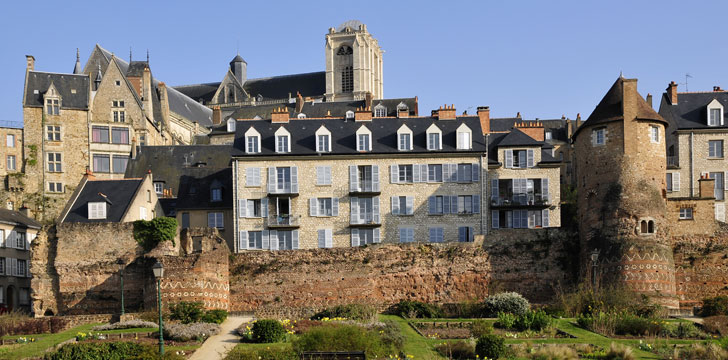
Parts of the quarter are enclosed by a Roman wall built in the third century. Eleven of its original 26 fortified towers survive, sharing the pinkish colouring of the curtain wall. First intended as protection during the late Roman period, the enclosure continued to serve the town in the Middle Ages.
Another trace of Roman Vindunum lies beneath the former fine-arts school. The baths were uncovered by chance during building work in 1980. Their remains recall a public complex used between the first and third centuries, with underground exhibition spaces created around part of the site.
Cathedral, palace and abbey
Saint-Julien Cathedral developed between the eleventh and fifteenth centuries, which accounts for its combination of Romanesque and Gothic architecture. Outside, its flying buttresses and single 64-metre tower define the silhouette. Inside, high vaults and thirteenth-century stained glass are among the principal surviving features.
The former Plantagenet royal palace stands nearby. Built between 970 and 1015, it became the main residence of Geoffrey V of Anjou, father of Henry II of England. Henry was born here in 1133. The stone complex later became Le Mans City Hall, retaining a direct physical link between the old city and the dynasty that took its name from Plantagenet.
Saint-Pierre-la-Cour, founded in the tenth century, once served both as a collegiate church and as the parish chapel of the Counts of Maine. Its adapted lower level has been used for exhibitions and musical performances. Two other churches show later phases of the city’s religious architecture: Notre-Dame de la Couture has a substantial twelfth-century Gothic front and a vaulted crypt, while the Church of the Visitation combines a restrained Régence building with a columned façade.
On the edge of Le Mans, the Cistercian Abbaye de l’Épau was founded in the thirteenth century by Berengaria, queen consort of Richard I of England. The abbey endured fires, abandonment and a period of agricultural use, but its spare monastic architecture and the queen’s recumbent effigy preserve its original associations.
Museums, gardens and motor racing
The Musée de Tessé occupies a nineteenth-century mansion and brings together paintings from the fourteenth to the twentieth century with Egyptian antiquities. Its basement contains full-scale reconstructions of the tombs of Nefertari and Sennefer. In the old town, the Musée de la Reine Bérengère is housed in a listed fifteenth-century building; its paintings, furniture and objects document local life, particularly in the eighteenth and nineteenth centuries.
For a change of scale, the eight-hectare Jardin des Plantes is divided between a formal French garden with a rose garden and an English-style landscape arranged around a large pool.
Motor-racing history is concentrated around the Circuit de la Sarthe. The 24 Hours of Le Mans was created in 1923, and the neighbouring museum traces the development of both the car and the race through a substantial vehicle collection. Together, the circuit and museum explain the modern sporting identity that sits alongside the Roman and Plantagenet city.