
City guide
Laon
Use the places and landmarks in this guide to plan visits at your own pace.
Read the guide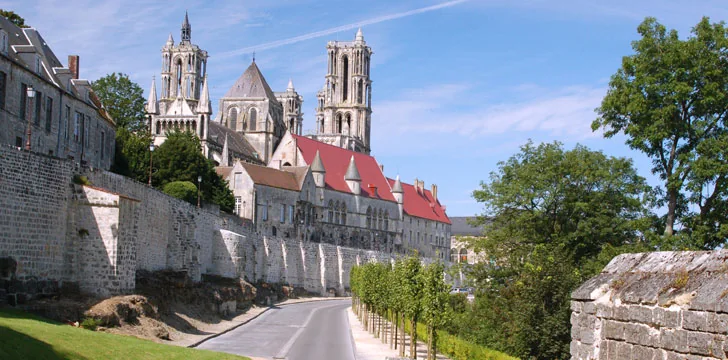
What to discover
Things to see in Laon
Laon’s upper town preserves a dense record of religious, civic and military history. Medieval streets cross the hill within eight kilometres of ramparts, passing the cathedral, former ecclesiastical buildings and four surviving monumental gates. Later defences and extensive underground galleries add further layers to the city’s architecture.
Around Notre-Dame Cathedral
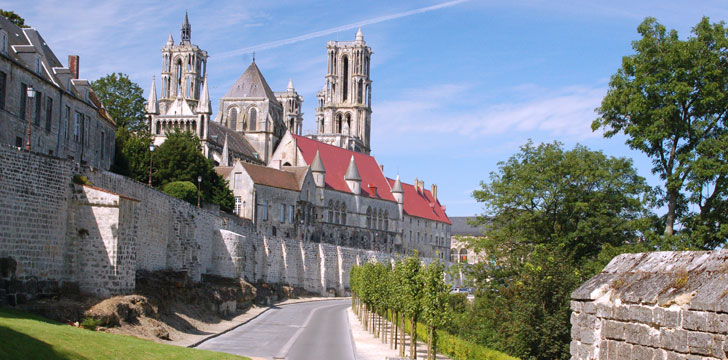
The present Notre-Dame Cathedral followed an uprising in 1112 during which its predecessor was destroyed. Construction began in 1155 under Bishop Gauthier de Mortagne. The building belongs to the early Gothic period and extends for 110 metres. Five monumental towers were completed: four bell towers and a lantern tower, rather than the seven originally planned. Their position above the town makes the cathedral the defining feature of Laon’s skyline. Its design influenced the later cathedrals of Chartres and Paris.
Beside the cathedral’s east end on Place Aubry, the former episcopal palace was the medieval residence of Laon’s bishops-dukes. It incorporates two superimposed chapels from the second half of the twelfth century, an arcaded gallery facing the courtyard and three turrets overlooking the ramparts. Its thirteenth-century great hall has capitals carved with foliage.
The former Hôtel-Dieu stands on the cathedral square. Built by the cathedral canons towards the end of the twelfth century, it is among the oldest surviving hospital buildings in France. Its ground floor was the ward, while the vaulted room below, now known as the Salle Bernard de Clairvaux, received travellers.
Templars, abbey and museum collections
The Romanesque Templar chapel dates from 1140, six years after the order established a commandery in Laon. Its octagonal nave and bell gable recall the religious architecture associated with Jerusalem. The choir contains the recumbent effigy of Guillaume de Harcigny, physician to King Charles VI in the late fourteenth century.
The former commandery also provides the setting for Laon’s museum of art and archaeology, founded in 1861. Its archaeological collections cover the region from prehistory to the Renaissance and the Mediterranean from the Bronze Age into the early centuries AD. Paintings span the fifteenth to nineteenth centuries, accompanied by sculpture, furniture and other works dating from the Middle Ages onwards.
Abbaye Saint-Martin was founded in 1124 for the Premonstratensian order. Saint Martin dividing his cloak with a beggar appears on the Gothic façade. The abbot’s residence and garden pavilion were built in brick and stone in 1620, and the cloister was reconstructed around 1730. After the Revolution, the complex was converted into an Hôtel-Dieu. A recreated cloister garden follows a medieval scheme, with medicinal plants, vegetables, fruit trees and paved walks.
Gates and ramparts
Porte de Soissons guards the south-western side of the medieval city. Two massive towers with arrow slits flank the gate, and part of a vaulted guardroom survives above. Close by, Tour Dame Ève leans because of ground movement; its name commemorates a woman who helped fund repairs to the walls.
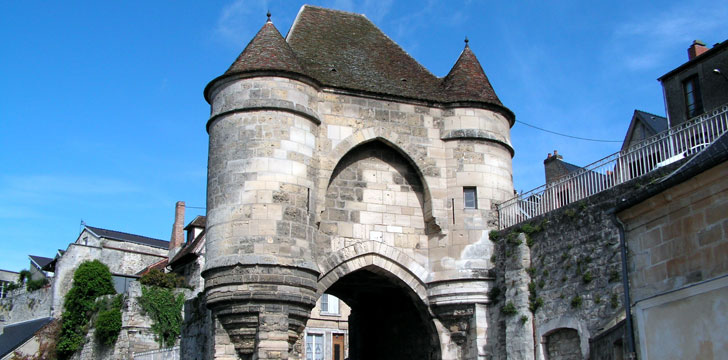
Porte d’Ardon is the oldest of Laon’s four surviving gates. Repeated alterations culminated in its small gatehouse form during the thirteenth-century restoration of the ramparts. A covered washhouse was built below it in 1823. Porte des Chenizelles, another thirteenth-century entrance, forms a pedestrian passage between the Bourg and the Cité. It once had two towers with conical roofs, a portcullis and an opening used to defend the gateway. Its name derives from medieval drainage channels.
Underground Laon and Fort Morlot
The galleries beneath the citadel trace changing uses from Gallo-Roman remains to a nineteenth-century firing range. Quarrying supplied stone as Laon expanded; the excavated spaces later became cellars, underground dwellings, ice houses and refuges during conflicts, including the Second World War.
Fort Morlot was built south of the plateau in 1878. Its optical telegraph communicated with the six forts of the Laonnois by using an oil lamp and mirrors to collect and direct light. The fort formed part of the national defensive building programme devised by military engineer General Raymond Adolphe Séré de Rivières after the defeat of 1870.
Keep exploring
More guides from the same area to help you continue your search.