
Things to see in Beauvais
Much of Beauvais was damaged by bombing during the Second World War, but important parts of its earlier architecture survived. The cathedral precinct contains the city’s principal medieval buildings, while timber-framed houses, a reconstructed civic square and collections linked to local tapestry production broaden the picture.
Saint-Pierre Cathedral and its clock
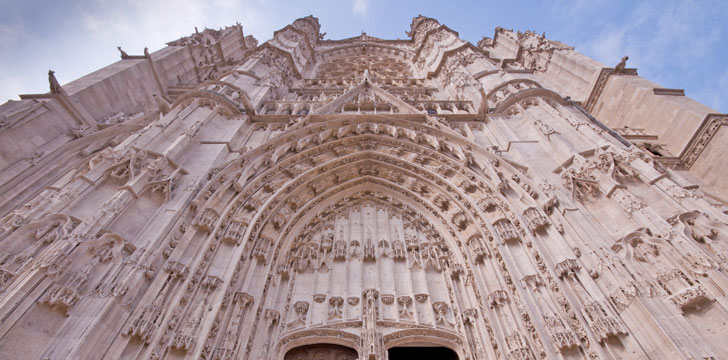
Saint-Pierre Cathedral is incomplete, yet its choir rises 48 metres beneath the vault. The scale of the building reflects an ambitious construction history marked by serious setbacks. Its spire collapsed in the sixteenth century, and the cathedral was left without a nave.
Inside the Chapelle du Saint-Sacrement is an astronomical clock designed by Auguste Vérité. Completed in 1876 after three years of work, it measures 12 metres high and 2.8 metres wide. Its mechanism has 90,000 components, including 68 automata that enact a Last Judgement scene on the hour. Fifty-two dials display astronomical information as well as tides and the rising and setting times of the sun and moon.
The former episcopal palace and museum
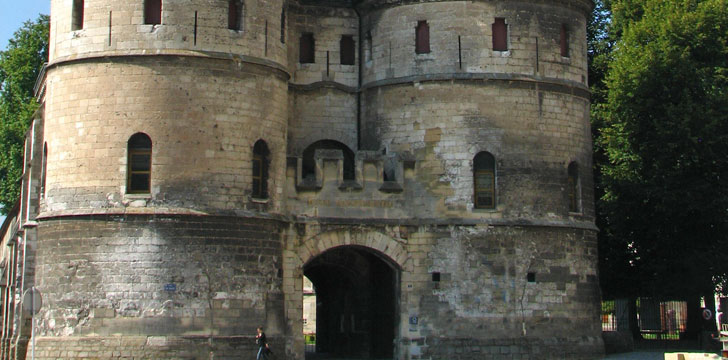
The former episcopal palace was built in the twelfth century on Beauvais’s Gallo-Roman ramparts. Early in the fourteenth century, Simon de Nesle, the city’s count-bishop, added a fortified entrance with two flanking towers. The main range was rebuilt in the sixteenth century, combining Renaissance design with Flamboyant Gothic ornament. After serving several administrations and then the law courts, the palace became the Musée départemental de l’Oise.
The museum collections described in the directory entry include tapestry, archaeology, graphic art, painting and furniture. French works range from Antoine Caron’s sixteenth-century Resurrection of Christ to nineteenth- and twentieth-century paintings by artists including Huet, Ingres, Vuillard and Le Sidaner. An Art Nouveau dining room by the Liège artist Gustave Serrurier-Bovy represents another strand of the collection.
Saint-Étienne and Saint-Lucien
Église Saint-Étienne combines a Romanesque nave built in the twelfth and thirteenth centuries with a sixteenth-century Flamboyant Gothic choir. Its stained glass was made by the Leprince family of glass painters. The best-known window is Engrand Leprince’s Tree of Jesse.
Little remains of Abbaye Saint-Lucien, a Benedictine foundation established at the end of the sixth century. The abbey closed in 1791 and was largely demolished during the nineteenth century. A section of the enclosure wall, the main entrance and a fifteenth-century tower survive.
Civic Beauvais and tapestry
Place Jeanne Hachette commemorates Jeanne Lainé, a young woman from Beauvais who resisted the troops of Charles the Bold with an axe in 1472, earning the name Jeanne Hachette. Gabriel-Vital Dubray’s statue of her stands at the centre. The square was heavily bombed during the Second World War and rebuilt in the 1950s.
Rue du 27 Juin escaped both the bombing of June 1940 and the fire that followed. Its surviving medieval half-timbered houses provide a sharp contrast with the reconstructed centre, and the street is now pedestrianised.
At the foot of the cathedral, the Galerie Nationale de la Tapisserie was created in 1964 on the initiative of culture minister André Malraux. Designed by architect André Herman and built against the old city walls, it was conceived to present four decades of work from the royal tapestry manufacture of Beauvais, together with furniture, paintings and graphic art.