
City guide
Amiens
Use the places and landmarks in this guide to plan visits at your own pace.
Read the guide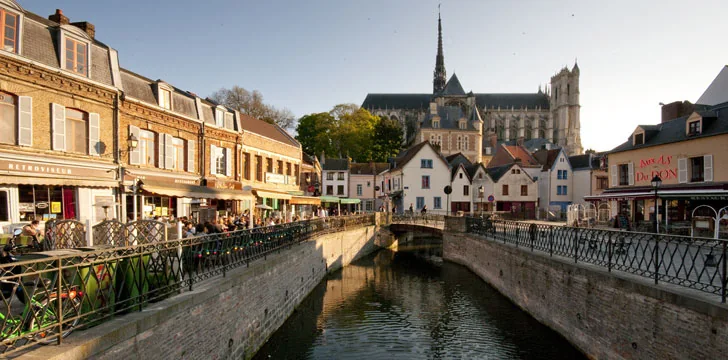
What to discover
Things to see in Amiens
Amiens combines a monumental Gothic centre with canals, market gardens and several places connected with Jules Verne. Its principal sights lie around Notre-Dame Cathedral, the pedestrian city centre and the waterside Saint-Leu quarter, while the Hortillonnages begin at the edge of the central area. The result is a city that can be explored through architecture, local history and a distinctive network of waterways.
Notre-Dame and the civic centre
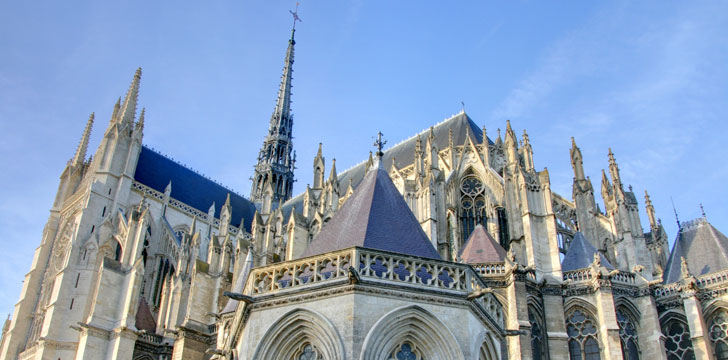
Notre-Dame Cathedral is the natural starting point for the historic centre. Built in the 13th century over a period of roughly 70 years, it is a major work of Gothic architecture. Its spire rises to 112 metres, while the vaults reach more than 42 metres inside. The richly worked façade gives a first sense of the building’s scale before entering the vast interior.
A useful line through the centre follows Rue des Trois Cailloux. This fully pedestrian street runs between the railway station and the Hôtel de Ville and has long been one of the city’s main thoroughfares. The town hall, erected across the 18th and 19th centuries, is a substantial U-shaped building of brick and stone. Its central staircase leads to an entrance framed by columns and statuary.
Between Rue des Trois Cailloux and the cathedral stands the Horloge Dewailly, an elaborate public clock dating from 1898 and partly reconstructed after the Second World War. Its metalwork incorporates plant forms and a figure leaning against the structure. The nearby belfry tells another part of Amiens’ civic story: its white-stone base was built between 1406 and 1410, while the upper sections reflect later restoration after wartime damage.
Saint-Leu and the Hortillonnages
Saint-Leu is the old canal quarter. Once associated with small artisans and poorer residents, it was rehabilitated during the 1990s. Cobbled lanes, closely set houses and channels of water give it a markedly different texture from the formal streets around the town hall. Its position beside the cathedral also makes it an easy continuation of a walk through the centre.
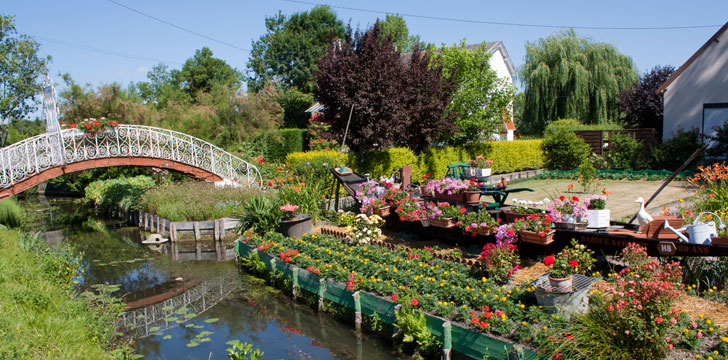
Just beyond Saint-Leu, the Hortillonnages extend across about 300 hectares of marshland. The land has long been divided into gardens separated by narrow canals, creating a landscape best understood from the water as well as from its edges. The varied trees and planted plots provide a quiet counterpoint to the stone monuments of central Amiens.
Jules Verne in Amiens
Jules Verne lived with his wife in the house now known as the Maison Jules Verne from 1882 to 1900. The townhouse became a museum devoted to his life and writing. Its most recognisable exterior feature is the tower, topped by a former observatory enclosed within a spherical metal structure.
The author’s name also belongs to the Cirque Jules Verne. Inspired by the Cirque d’Hiver in Paris, this polygonal, neoclassical building was constructed in the late 19th century for the city’s resident circus company. Its ornamented façades and roof are protected as historic features, and the building underwent a complete renovation in the early 2000s.
Museums and a quieter walk
The Musée de Picardie covers both art and archaeology. Opened in 1863, it was among the early French museums housed in a building designed specifically for that purpose. Its collections range across archaeology, medieval art, fine art, and modern and contemporary work. The Musée de l’Hôtel de Berny provides a more local focus in a Louis XIII-style townhouse dating from 1634, with woodwork, furniture, tapestries, ceramics and portraits linked to Amiens.
For a quieter historical setting, the Cimetière paysager de la Madeleine is laid out as a wooded, undulating cemetery. Pines and maples line paths among 19th-century family monuments, and Jules Verne’s grave is its best-known memorial.
Keep exploring
More guides from the same area to help you continue your search.