
City guide
Angoulême
Use the places and landmarks in this guide to plan visits at your own pace.
Read the guide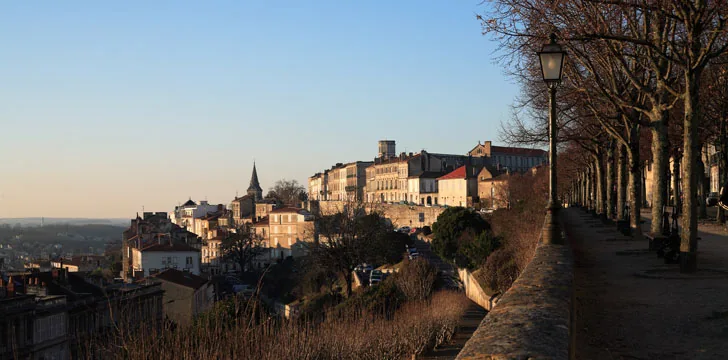
What to discover
Things to See in Angoulême
Angoulême occupies a rocky promontory about 80 metres above the winding Charente valley. Its elevated old town, repeatedly besieged over the centuries, retains a concentrated group of ramparts, churches and civic buildings. The city also has a distinct modern identity centred on comic-strip art and illustration.
The upper town and ramparts
The vieille ville lies between the central streets and the surviving defences. Its lanes and small squares bring together several of Angoulême’s principal monuments, including Cathédrale Saint-Pierre, the Hôtel de Ville and Hôtel Saint-Simon.
Place Beaulieu opens onto broad views of the surrounding country. Thirteenth-century stretches of rampart stand near Église Saint-Ausone, designed by Paul Abadie, and the Lycée Guez de Balzac. Elsewhere in the old town, Place du Minage recalls a long commercial role that lasted from the fourteenth to the nineteenth century. Its Second Empire fountain was inaugurated in 1869.
The Hôtel de Ville was built by Paul Abadie in the nineteenth century on the site of the counts of Angoulême’s castle. Two parts of the earlier complex survive: a keep with fabric from the twelfth and fourteenth centuries, and a fifteenth-century round tower known as the Tour de Marguerite. Tradition associates the latter with Marguerite d’Angoulême, sister of François I, who is said to have been born there in 1492.
Cathédrale Saint-Pierre and the city’s churches
The present Cathédrale Saint-Pierre dates principally from the twelfth century, after three earlier religious buildings occupied the site between the fifth and eleventh centuries. Built at the request of Bishop Girard II, it is a major example of Périgord Romanesque architecture. Its Poitevin façade is densely carved with medallions, figures and scenes including the Ascension and Last Judgement.
Damage during the Wars of Religion led to nineteenth-century restoration by Paul Abadie, who added a gable and two small bell towers with Byzantine influence. Inside, a single broad nave is divided into bays roofed by domes on pendentives.
Église Saint-André has an intentionally less uniform appearance because the building was damaged in both the Hundred Years’ War and the Wars of Religion. Its oldest surviving section is the porch, while the façade dates from 1825 and is neoclassical. Notre-Dame d’Obézine belongs to a later period: the neo-Gothic church was constructed between 1895 and 1960 on the site of an earlier chapel. Stained glass made by the Mauméjean brothers in 1942 combines saints with scenes from the New Testament.
Comics, art and local collections
Angoulême’s association with comics is expressed through the Cité Internationale de la Bande Dessinée et de l’Image. Spread across three buildings that combine modern structures with industrial remains, it brings together a comics museum, specialist and heritage libraries, a bookshop, an art-house cinema and an international artists’ residence. A collection of almost 5,000 original pages traces changes in drawing, storytelling and production techniques.
The International Comics Festival, established in 1974, reinforced the city’s place in the field. Its exhibitions and professional gatherings connect the festival programme with the collections and institutions present throughout the year.
For a broader account of the region, the Musée d’Angoulême occupies the former bishop’s palace in the historic centre. Its archaeology and palaeontology collections draw on finds from Charente, including prehistoric material and a fifth-century BC Gallic helmet. Further galleries cover African and Oceanian works as well as painting and sculpture from the sixteenth to the twentieth century.
Markets and Renaissance detail
Les Halles introduces the iron-and-glass architecture of the late nineteenth century. Designed by architect Édouard Warin and engineer Pommier, the market replaced a fortress in 1888 and drew inspiration from the Paris market halls.
Hôtel Saint-Simon preserves an earlier architectural layer. Built in the sixteenth century, its Renaissance façade has sculpted medallions, worked doorways and dormers with candelabrum ornament reminiscent of the Château de La Rochefoucauld. Beyond the monuments, the street circuit created in 1939 for the Circuit des Remparts adds a twentieth-century strand to Angoulême’s urban history.
Keep exploring
More guides from the same area to help you continue your search.