
City guide
Niort
Use the places and landmarks in this guide to plan visits at your own pace.
Read the guide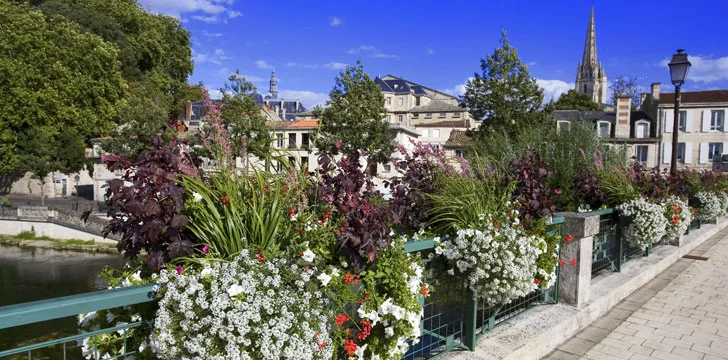
What to discover
Things to See in Niort
Niort, the departmental capital of Deux-Sèvres, is built on both banks of the Sèvre Niortaise. Its role as a centre for insurance and other service industries is one part of the city’s character; the older quarters reveal a longer history through a formidable medieval keep, churches, market architecture and riverside routes towards the Marais Poitevin.
The old town and Donjon
The historic centre extends across the river. On the left bank, the main shopping streets reach Place de la Brèche, while the Saint-André hill and Notre-Dame quarter retain older lanes. The Bessac quarter lies on the right bank and is traditionally associated with the first settlement of the site in the Gallo-Roman period.
Niort’s Donjon is not a single tower but a pair of massive Romanesque keeps. Henry II commissioned the complex in the late twelfth century, and the twin towers once formed part of a castle said to have extended for more than 700 metres. Their severe masonry and close-set forms make the building the clearest surviving expression of medieval power in the centre.
Le Pilori records the city’s later civic history. This former town hall was erected in the sixteenth century on the site of the medieval pillory and follows an unusual trapezoidal plan. Its principal fabric is Renaissance, while the upper part of the belfry dates from the eighteenth century. Sculpted pediments, gargoyles and mouldings animate the exterior; inside is a painted fireplace with plant ornament.
Churches and museum collections
Église Notre-Dame developed from an earlier Romanesque church whose origins reach back to the fourteenth century. Extensive work in the fifteenth and sixteenth centuries gave it a Flamboyant Gothic appearance. Its 75-metre bell tower is a city landmark, and Mathurin Berthomé’s north portal combines Gothic and Renaissance motifs in a composition dedicated to the Virgin.
Église Saint-André has been rebuilt several times. A medieval successor to the original Romanesque church was enlarged during the Renaissance, damaged in the Wars of Religion and reconstructed by the end of the seventeenth century. The present building belongs to the second half of the nineteenth century, with the complex history explaining the contrast between it and the surviving remains of its predecessors.
The Musée Bernard-d’Agesci occupies the former Jean-Macé girls’ school. Its collections bring fine art, natural history and the history of education into one institution. The education collection includes scientific apparatus, maps, books and school films documenting more than a century and a half of teaching in France.
Markets and public spaces
Les Halles demonstrates the possibilities of nineteenth-century iron construction. Completed in 1885 in a style associated with Baltard’s Paris markets, the building uses cast iron and steel. A central nave and two aisles organise the interior, while arcaded façades make the entrances easy to identify.
Place de la Brèche marks the edge of the historic centre. Once occupied by a large open-air car park, it was redesigned with parking below ground and public gardens at surface level; cafés, restaurants and a cinema occupy the lower part of the square. The change created a broad pedestrian space between the old town and the newer city.
Along the Sèvre and into the Marais Poitevin
The Coulée Verte follows developed quays and banks from Niort towards Magné, at the threshold of the Marais Poitevin. Its route crosses between small islands and the two sides of the river, allowing the wetland landscape to appear before the city has fully receded.
Beyond Magné, the Marais Poitevin extends across Deux-Sèvres, Vendée and Charente-Maritime. It contains both drained and wet marshes, with waterways traditionally explored by boat. The water, low-lying vegetation and close network of channels account for the wet marshland’s familiar Green Venice name.
Another medieval site lies outside the centre at Château du Coudray-Salbart. The thirteenth-century military fortress displays Plantagenet features, notably almond-shaped towers and a circulation passage built within the thickness of the walls. Archaeological excavation in 2005 added to the understanding of this unusually complete defensive complex.
Keep exploring
More guides from the same area to help you continue your search.