
What to see in Poitiers
Poitiers stands on a broad plateau above the Boivre and Clain valleys, joined to the surrounding land by the narrow neck known as La Tranchée. This distinctive setting frames a centre rich in Romanesque churches and medieval civic architecture, but the city’s story also extends to twentieth-century museums and multimedia attractions.
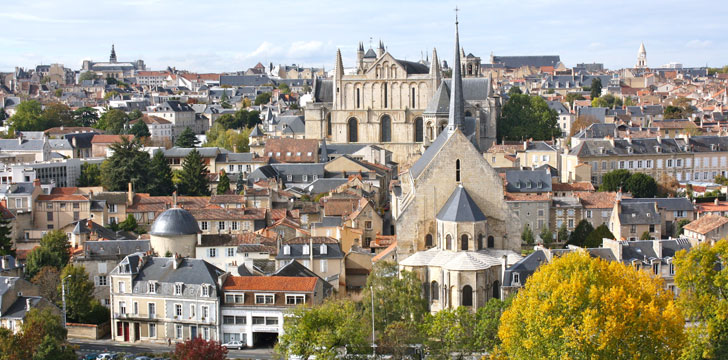
Early Christian and Romanesque Poitiers
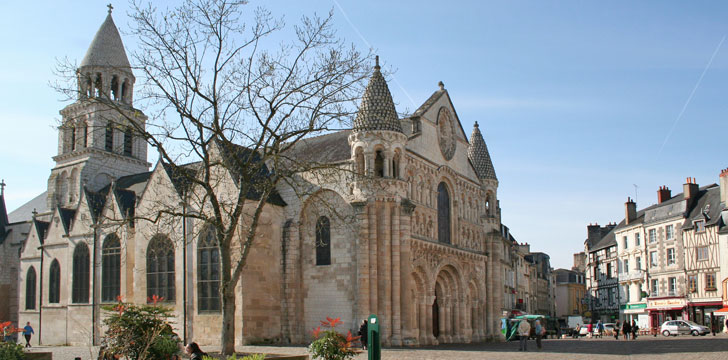
Notre-Dame-la-Grande is distinguished by an exceptionally elaborate carved façade. Its design became influential elsewhere in Poitou, and the scaled pattern of its roof has parallels in later French church architecture. A restoration carried out between 1992 and 1995 renewed the exterior stonework without changing the building’s defining Romanesque character.
The Baptistère Saint-Jean reaches further back. Parts of this small building date from the fourth century, around the period of Saint Hilary, Poitiers’ first bishop. Its octagonal baptismal pool was made for baptism by immersion. Wall paintings, the earliest from the eleventh century, and a collection of Merovingian sarcophagi reveal how the site continued to evolve after late antiquity.
Saint-Hilaire-le-Grand was built in the eleventh century and bears the marks of later damage during the Wars of Religion and the Revolution. Sainte-Radegonde combines Romanesque and Angevin Gothic work around a much older pilgrimage tradition. Its apse and crypt date to the tenth century, while the nave and vaults belong to later medieval phases.
Palaces and civic architecture
The former palace of the Counts of Poitou occupies a site long associated with the exercise of power. Closely connected with the Plantagenets, it contains one of the city’s major medieval interiors: the vast reception hall known as the Salle des Pas Perdus, with monumental sculpted fireplaces and Flamboyant Gothic work.
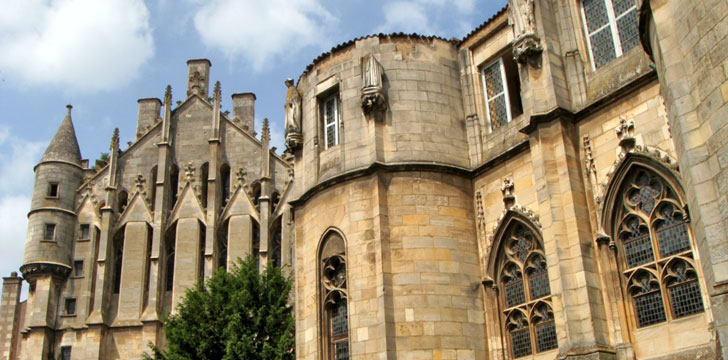
Hôtel Fumé represents a more domestic form of Flamboyant Gothic architecture. Begun as a private residence in the fifteenth century, it was enlarged in the sixteenth by François Fumé, who remodelled the façade and added extensive sculpture. The building later became part of the University of Poitiers.
On Place du Maréchal Leclerc, the Hôtel de Ville belongs to the Second Empire. Its design combines Renaissance-inspired columns with the symmetry associated with the age of Louis XIV. Inside, the main staircase is decorated with paintings by Puvis de Chavannes illustrating episodes from the city’s history.
The Musée Sainte-Croix
Poitiers’ largest museum takes the architectural story into the 1970s. The Musée Sainte-Croix is a concrete-and-steel Brutalist building constructed over an archaeological site. Its art collection includes work by Camille Claudel, Auguste Rodin, Piet Mondrian and Max Ernst, while the archaeology displays include prehistoric sculpture. The contrast with the medieval centre is useful: Poitiers has continued to add substantial public architecture rather than presenting history as a single period.
Futuroscope and the Bois de Saint-Pierre
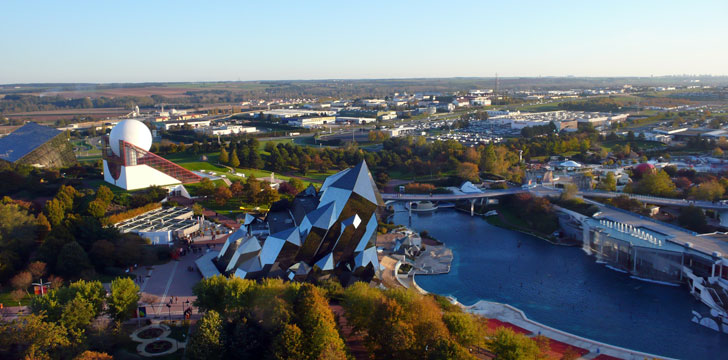
Futuroscope provides the clearest shift away from historic monuments. Set within its associated technology park, it was conceived around multimedia, audiovisual techniques and robotics. Its visual experiences have included three- and four-dimensional films and projections on hemispherical or 360-degree screens.
Seven kilometres from the centre, the Bois de Saint-Pierre offers a contrasting landscape. The city acquired this roughly 250-hectare woodland in 1968 and developed it for recreation while retaining much of its wooded character. Walking and riding paths run through the site, extending a visit beyond the plateau and its built heritage.