
Things to see in Digne-les-Bains
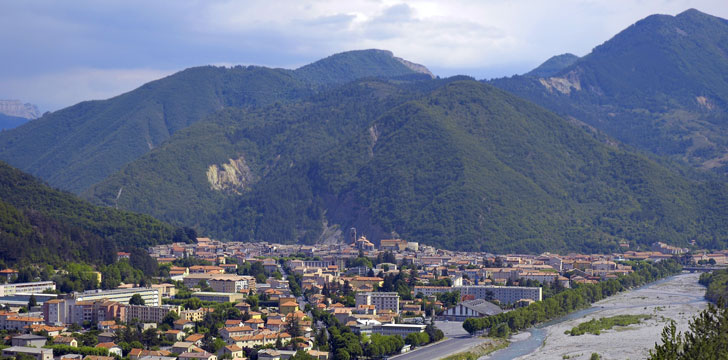
Digne-les-Bains lies where Alpine landscapes meet Provence. Its visitor sites are unusually varied: two cathedrals reveal successive layers of religious history, museums connect art with the natural sciences, and geological displays extend into parks and open countryside. The town’s thermal tradition and its links with the explorer Alexandra David-Néel add further strands to the story.
Cathedrals and archaeology
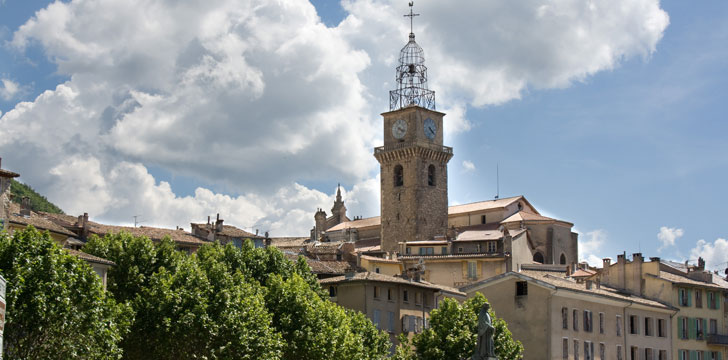
Notre-Dame-du-Bourg is the older of the town’s two cathedrals. Its foundations date from the 9th century, though attacks, looting and bombardment caused repeated damage over its long history. The building has an austere Romanesque character: a large rose window relieves the modest façade, while the long, dark nave retains a deliberately spare appearance.
Below the cathedral, the archaeological crypt exposes a much earlier sequence of occupation. Restoration work begun in the 1980s uncovered walls from the 1st century and evidence of three religious buildings erected between the 5th and 11th centuries. The remains help place the origins and subsequent development of Digne on a single site rather than presenting the cathedral in isolation.
Saint-Jérôme became the principal episcopal church in place of Notre-Dame-du-Bourg. It was built between 1490 and 1500, although the present façade belongs to the mid-19th century. Its more elaborate interior includes several chapels, a decorated nave and a gallery organ dating from 1865. The Chapelle des Pénitents within the complex houses the Musée d’Art Religieux, whose collections draw on liturgical objects from parishes across the department.
Art, exploration and public spaces
The Musée Gassendi combines the approaches of a natural-history museum and a fine-arts collection. Displays move between science, historic art and contemporary work rather than separating them into unrelated subjects. Its open-air route continues this idea into the surrounding landscape, where works and sculptures by several artists can be encountered outside the conventional gallery setting.
Alexandra David-Néel’s final home is now devoted to the traveller, writer and her engagement with Himalayan culture. Her works and collections connect Digne-les-Bains with the Asian journeys for which she became known, including her stay in Lhasa. The house provides a sharply different perspective from the town’s ecclesiastical monuments.
Within the town, the Grande Fontaine has supplied a prominent architectural landmark since 1828. Its columns and basins draw on Roman forms. North of Digne, the ruined Chapelle Notre-Dame de Lourdes dates from 1870 and was planned as a replica of the sanctuary at Lourdes. A path from the site also leads towards the rural chapels of Saint-Vincent and La Croix.
A landscape shaped by geology
The Musée Promenade of the Haute-Provence Geological Reserve places part of its interpretation outdoors in a large wooded park. Themed paths, streams, waterfalls and gardens complement exhibition rooms concerned with the history of the Earth. The associated butterfly garden also uses an open setting, allowing visitors to observe locally occurring butterflies rather than a collection detached from their habitat.
About 1.5 kilometres north of the town, the Dalle à Ammonites makes that geological history visible at full scale. More than 1,500 fossilised ammonites lie across an inclined rock surface of roughly 350 square metres; some individual fossils measure over 70 centimetres. The slab was revealed during road works and is one of the area’s most direct encounters with its prehistoric past.
The thermal identity of Digne
Hot water has been associated with Digne since antiquity, and the local spring is recorded at around 50°C. Centuries of spa activity are embedded in both the town’s history and its name. This thermal heritage sits alongside the museums, archaeological remains and outdoor geological sites, making water and landscape recurring themes rather than a separate resort story.