
Things to see in Gap
Gap stands on the Route Napoléon, close to the mountain landscapes of Écrins National Park. Its old centre is characterised by narrow streets, small squares and houses with warm-coloured façades, while museums and green spaces open the town towards the wider history and environment of the Hautes-Alpes.
Streets and squares of the old town
The historic centre retains a street pattern inherited from the medieval town. Winding passages run between ochre, pink and yellow façades, with fountains and compact squares breaking up the route. Although many of the houses themselves are not medieval, their colours give the centre a distinctly southern appearance.
Place Jean Marcellin lies where several pedestrian and shopping streets meet. A fountain and rows of colourful buildings shape the square, while the Hôtel de Ville provides its principal civic landmark with an 18th-century façade. It is a useful point from which to explore the old town on foot rather than treating the centre as a collection of isolated monuments.
The cathedral and departmental museum
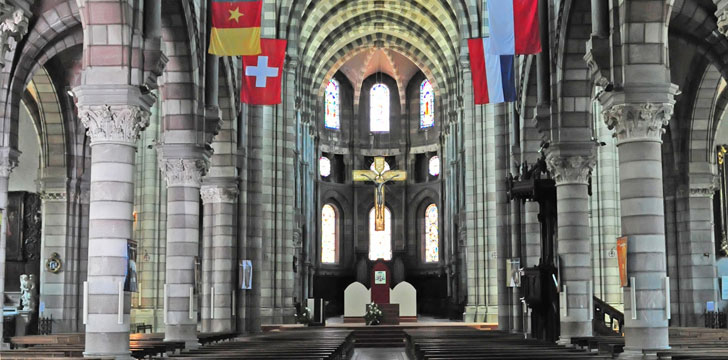
Notre-Dame-et-Saint-Arnoux Cathedral was designed by the architect Charles Laisné and built in the 19th century in a Provençal Romanesque revival style. Its most conspicuous feature is a 70-metre bell tower. Local stone creates alternating bands of white, red and grey across the polychrome façade. The building was listed as a historic monument in 1906.
The Musée Départemental des Hautes-Alpes is located in Parc de la Pépinière. Its varied collections include ceramics from Nevers and Moustiers, historic weapons and carved furniture. Archaeology and prehistory displays contain a double bust of Jupiter Ammon and Bronze Age ornaments from sites including Bénévent and Réallon. Bas-reliefs from the mausoleum of François de Bonne, Duke of Lesdiguières, depict episodes such as the taking of Grenoble and the victory of Pontcharra.
Parks and the Domaine de Charance
Parc de la Pépinière provides a green space in the centre of Gap. Many of its trees were planted in the 19th century, and a bandstand installed in 1911 adds a period feature to the grounds. The museum and park can therefore be visited as part of the same walk.
Above the valley, the 220-hectare Domaine de Charance offers a different scale of landscape and broad views towards the Alps. The estate contains the 16th-century Château de Charance and its outbuildings. It is also associated with Écrins National Park and the Conservatoire botanique national alpin, while its gardens include a substantial rose collection. The combination of historic buildings, cultivated grounds and mountain views makes Charance a natural extension to a visit to central Gap.
Gateway to the Écrins
Écrins National Park covers much of the Écrins massif and places Gap near a markedly high-mountain environment. Its walking routes pass peaks, glaciers, Alpine pasture, lakes, waterfalls and mountain villages. The long-distance GR 54 is among the marked trails crossing this landscape, with mountain refuges supporting longer routes.
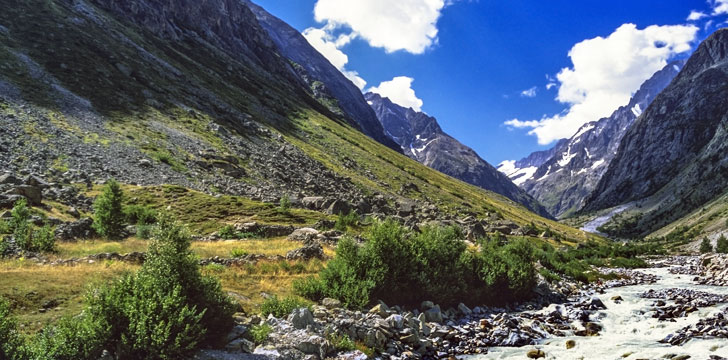
The old town, Pépinière and Charance each reveal a different relationship with the surrounding region. In the centre, Alpine history appears through collections and architecture; at Charance, botanical study and designed gardens meet the valley landscape; beyond the town, paths continue into the Écrins massif.