
Things to see in Toulon
Toulon’s identity is closely tied to its Mediterranean roadstead and naval base. The waterfront, successive rings of fortification and the military heritage of Mont Faron provide the main historical thread, while the Haute-Ville and Mourillon show different sides of the modern city.
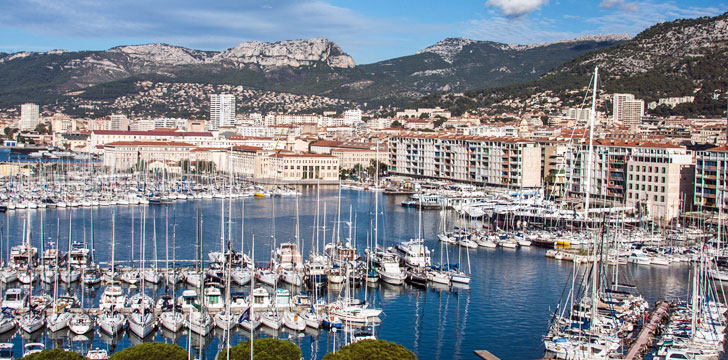
The harbour and naval history
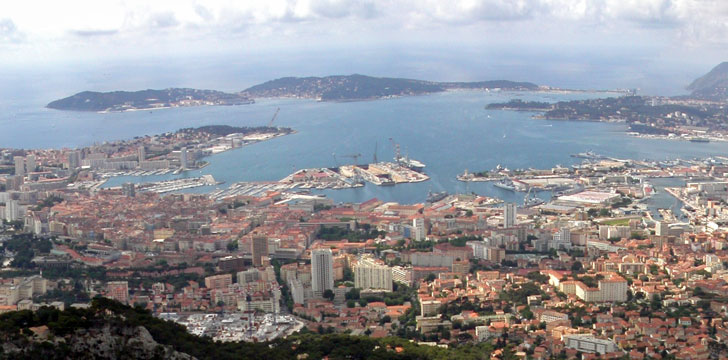
The Rade de Toulon has shaped the city since antiquity and contains both civilian and military port areas. The wider roadstead is framed by the Giens peninsula to the east and Saint-Mandrier to the south. This geography explains why Toulon became one of France’s principal naval bases alongside Brest and Cherbourg.
Near the arsenal clock tower on place Monsenergue, the Musée National de la Marine traces this maritime history through ship models and permanent displays on the French Navy. On the waterfront, the compact Carré du Port contains Louis-Joseph Daumas’s 1847 statue of the Génie de la Navigation. The figure faces the sea with its back to the city, a detail that has become closely associated with the harbour.
Fortifications around the roadstead
Toulon’s defences were constructed in stages. The Tour Royale, also called the Grosse Tour, was ordered by Louis XII to guard the harbour approaches. Italian architect Jean-Antoine de la Porta directed its construction at the end of cap de la Manègue. Its broad cannon-tower form set a pattern for later military works around the site.
Fort Saint-Louis at Le Mourillon belongs to the reign of Louis XIV. It was destroyed during the 1707 siege by British and Austrian forces, then rebuilt to the same design. Fort Balaguier dates from the era of the Tour Royale. Its circular structure is about 20 metres in diameter, with walls four metres thick; the garrison occupied the upper level, while water and provisions were kept below.
Squares, opera and the Mourillon
Place de la Liberté is the principal square of the Haute-Ville, within a nineteenth-century Haussmann-style street plan. The large building on its edge has served at different times as a hotel, theatre and maritime prefecture. At the centre, the Fontaine de la Fédération carries stone figures representing Strength, Justice and France.
Toulon’s opera house was built in 1860 by Léon Fauchère. Its principal frontage opens onto place Victor-Hugo, with a second entrance on boulevard de Strasbourg. The building predates the Palais Garnier in Paris by thirteen years and was designed specifically for opera. The Mourillon district brings the city back to the water through a group of beaches a few kilometres from the centre.
Mont Faron and the Provence landings
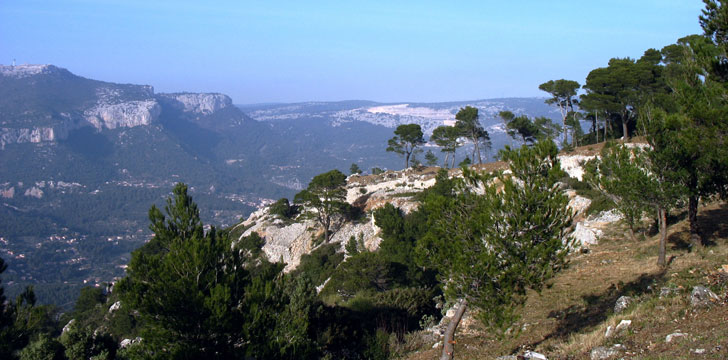
Mont Faron is a pine-covered limestone massif rising to 584 metres immediately north of Toulon. Views from the mountain take in the city and roadstead, but the summit also extends the area’s military story. Defensive remains include Fort du Mont Faron, ordered under Louis XV, the connected Fort de la Croix-Faron and nearby Fort Saint-Antoine. A retrenched barracks built in 1764 survives beside the fortifications, together with its rainwater-collection structure.
The Mémorial du Débarquement en Provence occupies Tour Beaumont on Mont Faron. Established in 1945, it commemorates the Allied landings in Provence on 15 August 1944 through models and historical reconstructions. Its setting links the events of the Second World War with the much longer history of defending Toulon and its harbour.