
Things to see in Avignon
Avignon’s streets, squares and monuments still reflect the period when the city was a centre of Western Christianity. The compact historic core brings the Palais des Papes, the cathedral and the Rhône-side fortifications within a relatively small area, while civic buildings around Place de l’Horloge reveal a later chapter of the city’s history.
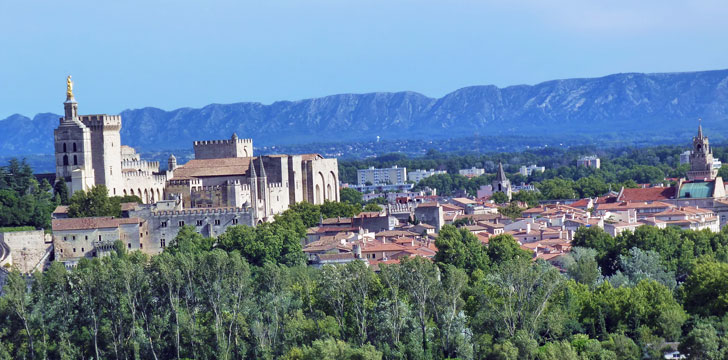
The papal quarter
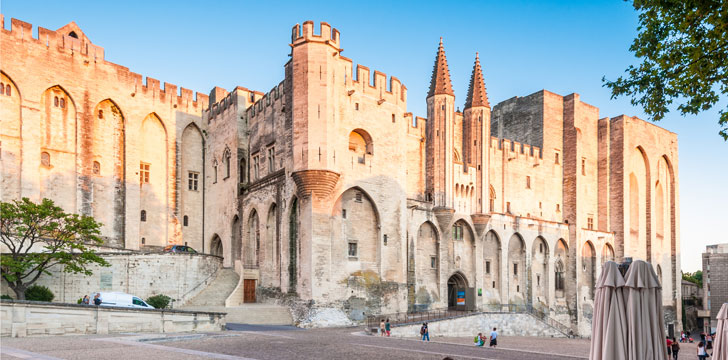
The Palais des Papes occupies the Rocher des Doms and is the defining monument of papal Avignon. Construction began in 1335, producing an immense Gothic complex of ceremonial rooms, private apartments and courtyards. Frescoes by Matteo Giovannetti survive inside, and the Cour d’Honneur has a continuing cultural role as a performance space during the Festival d’Avignon.
Notre-Dame des Doms stands beside the palace, with a gilded figure of the Virgin above it and views over the Rhône valley. Work on the cathedral began in the 12th century. Its nave and bell tower came first, followed by the cupola and porch; side chapels were added during the Middle Ages. Seen together, palace and cathedral make the Rocher des Doms the clearest place to understand the city’s medieval religious importance.
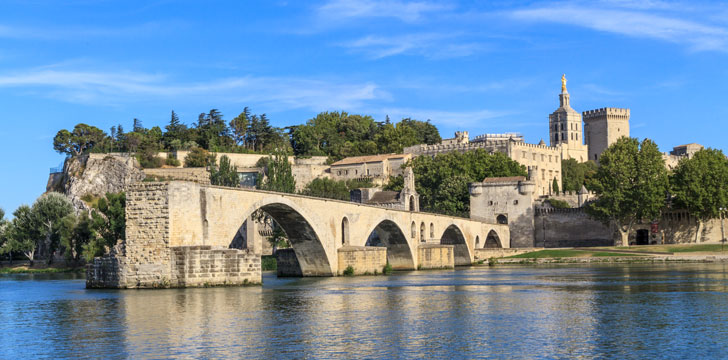
The bridge and city walls
Pont Saint-Bénézet is better known outside France as the Pont d’Avignon, thanks to the song associated with it. The bridge was built in the 12th century but repeatedly suffered damage during floods on the Rhône. It was eventually left incomplete in the 17th century; four of its original 22 arches remain.
The medieval walls form another strong feature of the cityscape. They were intended to defend the old city both from flooding and from armed companies moving through the region during the Hundred Years’ War. The main phase was completed in 1370 under Pope Urban V. Viollet-le-Duc carried out work in the late 19th century, including the buttresses now visible along the circuit. A walk beside the walls can be combined with the bridge and the garden of the Rocher des Doms.
Place de l’Horloge and the cultural city
Place de l’Horloge occupies the civic heart of Avignon on the site associated with the ancient forum. Plane trees, café terraces and public buildings frame the square. The Hôtel de Ville was erected in 1844 and has a restrained Neoclassical façade with four Greek-inspired columns. Above it, the earlier clock tower and its carillon survive from the former Livrée d’Albano.
The Opéra d’Avignon stands nearby. An initial theatre opened in 1825 but was destroyed by fire; its successor was built in 1846 in an Italianate theatre style. Statues of Molière and Corneille flank the principal entrance. The building belongs to a broader performance tradition that reaches well beyond the opera house.
In July, the Festival d’Avignon uses historic spaces throughout the city for contemporary theatre and other performances. Cloisters, chapels, theatres and the Cour d’Honneur of the Palais des Papes all become venues. This relationship between architecture and live performance is central to modern Avignon: the monuments are not simply a preserved backdrop, but active parts of the city’s cultural life.