
Things to see in Bourg-en-Bresse
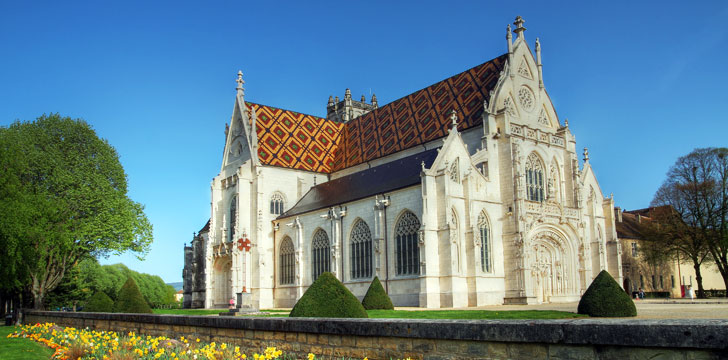
Bourg-en-Bresse brings together several distinct chapters of local history within and around its centre. The old town contains medieval timber-framed houses and later stone residences, while the city’s churches, museum and former hospital pharmacy broaden the picture. The Royal Monastery of Brou is the most elaborate of these sites.
Architecture in the old town
A walk through the Vieille Ville reveals traces of an early Celtic settlement alongside buildings from much later periods. Half-timbered houses survive from the Middle Ages; eighteenth-century town houses and private mansions are distinguished by dressed stone and wrought-iron balconies.
The Gothic Porte des Jacobins once led into a fifteenth-century Dominican convent. The convent was destroyed during the Revolution, leaving the gateway as a reminder of the complex in the heart of the old town.
Nearby, the Co-Cathedral of Notre-Dame de l’Annonciation was built largely during the sixteenth century, although later additions changed its appearance. Its Renaissance frontage and bell tower rise to 70 metres. The organ was installed in 1682, and the stained glass dates from the nineteenth and twentieth centuries because the earlier windows were destroyed during the Revolution.
The Royal Monastery of Brou
Built at the beginning of the sixteenth century, the Royal Monastery of Brou is a group of monastic buildings associated with the Flamboyant Gothic tradition. The main church has a richly worked Renaissance façade, while the Chapel of the Virgin provides a more intimate example of the interior decoration.
Bourg-en-Bresse’s municipal museum occupies one of the monastery buildings. Its ground floor covers religious sculpture from the thirteenth to the seventeenth centuries. Upstairs, paintings include Flemish and French works dating from the sixteenth to the twentieth centuries. Temporary exhibitions have also supplemented the permanent displays.
Churches and the Hôtel-Dieu apothecary
The Basilica of the Sacré-Cœur looks older than it is: its design draws on late-medieval and Renaissance church architecture, but construction took place between 1911 and 1942. Its stained-glass windows are a notable feature of the interior.
Another part of the city’s heritage survives at the Apothecary of the Hôtel-Dieu, formerly the hospital pharmacy. Its three rooms comprise the dispensary, a back shop with period shelving and woodwork, and a laboratory whose equipment has been retained. Collections of earthenware jars occupy the shelves once used for medicines.
Parc de la Visitation
The former garden of the Sisters of the Visitation is now an urban park. Its mature trees create a woodland-like setting for a walk. At its centre is a small earth mound known as a poype, an intriguing feature whose origins the destination account leaves unresolved.