
Things to see in Valence
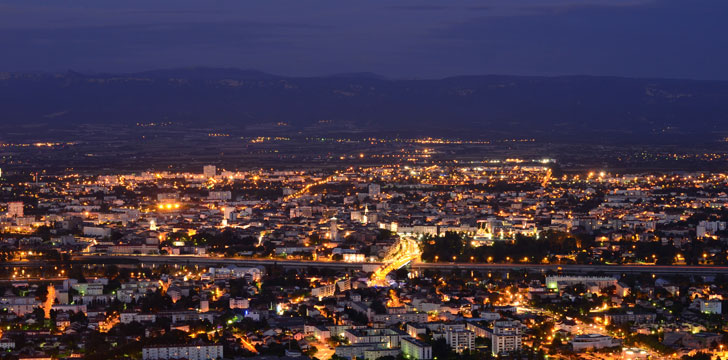
Valence, capital of the Drôme, sits roughly midway between Lyon and Avignon. Its historic centre combines Romanesque and Renaissance architecture with later civic monuments. Beyond the old streets, gardens and canals introduce the city’s relationship with the Rhône landscape.
The old town and its Renaissance houses
Vieux Valence is characterised by worked façades, internal courtyards with loggias, decorative doorways and paired windows. Saint-Apollinaire Cathedral stands in the upper part of the old town. Built in the eleventh century in an Auvergnat Romanesque style, it has a sculpted porch, a vaulted nave and a cenotaph bust of Pope Pius VI. The cathedral forecourt looks across the city and the Rhône.
The Maison des Têtes was built between 1528 and 1532 for Antoine de Dome, a city consul and university law professor. Its architecture marks the shift from Flamboyant Gothic to the Renaissance. Four large heads in high relief give the house its name, while other figures refer to subjects including the winds, theology, fortune, time and medicine. A Gothic entrance retains joinery from the Louis XIV period.
Close by, the Pendentif is a Renaissance funerary monument erected in 1548 for Canon Mistral in the cathedral cloister. Its triumphal-arch form and distinctive pendentive vault reflect renewed interest in classical architecture. The Maison Dupré-Latour, built around 1522 for the Génas family of salt merchants, has a Renaissance stair turret. Carving around its courtyard doorway depicts episodes from classical mythology.
Art and surviving religious buildings
The Musée des Beaux-Arts occupies the former episcopal palace. Its paintings, sculpture, drawings and decorative arts trace developments from the sixteenth to the twentieth century. The collection includes red-chalk drawings by Hubert Robert and drawings by Fragonard. Archaeological displays range from the Palaeolithic to the Middle Ages and include Gallo-Roman mosaics depicting the labours of Hercules and Orpheus charming the animals.
Other fragments reveal how the city changed. The eighteenth-century Saint-Ruf portal is one of the remnants associated with the former abbey palace; that palace later housed the Drôme prefecture before its destruction in the bombing of 1944. The Chapelle des Cordeliers is the sole survivor of a twelfth-century convent rebuilt in the seventeenth century after the Wars of Religion. Its restrained façade is set off by a monumental Baroque portal with its original joinery.
The Champ-de-Mars and Parc Jouvet
The Peynet kiosk, a bandstand built on the Champ-de-Mars in 1862, acquired its best-known association in 1942, when it inspired Raymond Peynet’s celebrated pair of lovers. It was restored after being listed as a historic monument in 1982. The nearby bronze statue of General Championnet was made by Grenoble sculptor Victor Sappey and erected in 1844. Hidden during the Second World War, it returned to its original position in 1944.
Parc Jouvet extends from the Champ-de-Mars across seven hectares. Opened on 13 August 1905 as the city’s first public park, it contains a broad variety of trees and plants and offers views towards the Rhône and the Vivarais hills.
Canals and Château de Crussol
Watercourses have run through Valence since the Roman period. They once supported fishing, irrigation, laundry and the mills built along their banks. The network still passes through several districts, with walking routes following parts of this water heritage.
Across the Rhône valley, the ruins of Château de Crussol occupy the mountain above Valence. Construction of the medieval fortress began in 1110 under Gérald Bastet, and alterations continued into the fourteenth century. At its greatest extent, the site covered more than three hectares behind roughly 800 metres of crenellated walls. The approach passes through the remains of the former village before reaching the castle ruins and their wide view over the valley.