
Things to see in Annecy
Annecy is organised around its lake, the River Thiou and the canals that cross the old centre. Water is a constant presence beside its medieval buildings, arcaded streets and broad lakeside lawns. The city also has a strong religious legacy, with churches associated with François de Sales and Jeanne de Chantal.
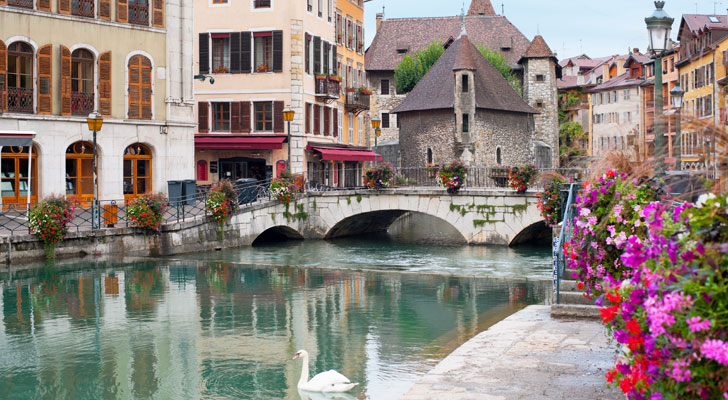
The old town and its castles
The Palais de l’Isle stands on a small island in the Thiou and is one of the clearest expressions of Annecy’s relationship with the river. This medieval stronghouse had several practical roles over the centuries: it collected tolls from passing boats, housed a mint and served as a prison. It later became a museum concerned with Annecy’s architecture and heritage.
Nearby, pedestrianised rue Sainte-Claire is lined with arcades dating from the seventeenth and eighteenth centuries. Its covered frontages, terraces and small shops create a direct route through the old centre without separating everyday commercial life from the historic setting.
Château d’Annecy rises on a rocky spur of the Semnoz above the town. The fortified castle dates from the twelfth century and was a residence of the Counts of Geneva and the Dukes of Nemours. After a serious fire in the 1950s, the municipality restored the building; it subsequently housed a museum and the regional observatory of Alpine lakes.
Churches above and within Annecy
The spire of the Basilica of the Visitation is visible above the Semnoz foothills. Built during the 1930s away from the increasingly busy centre, the basilica is dedicated to Jeanne de Chantal and François de Sales and is associated with the Visitandine community.
In the centre, the seventeenth-century Church of Saint-François de Sales is sometimes known as the Church of the Italians because of the community that first attended it. The building was connected with the beatification of François de Sales and Jeanne de Chantal and contains their tombs. Damaged during the French Revolution, it survived through the efforts of local worshippers who campaigned for its restoration.
Along the lake
Pont des Amours crosses the Canal du Vassé near the lake, with views towards Île aux Cygnes and the moored boats along the canal quays. It also connects two important green spaces: the Jardins de l’Europe and the Pâquier.
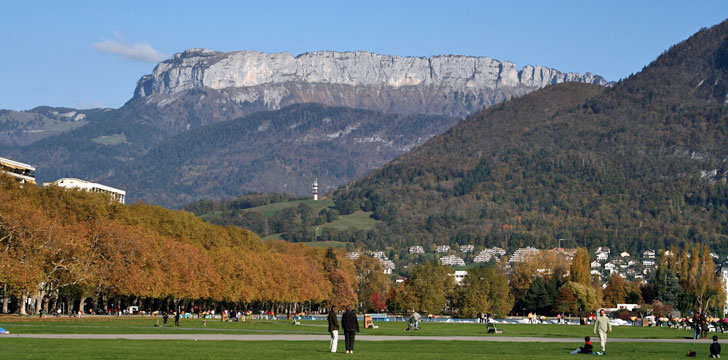
The Pâquier is a lakeside esplanade of more than seven hectares. Its lawns and surfaced paths extend towards the Impérial grounds, providing an open counterpoint to the narrow streets of the old town. The Marquisats and Impérial lakefronts continue Annecy’s close connection with the water.
Excursions west of Annecy
Two sites near Lovagny add a different setting to a stay in Annecy. Château de Montrottier, about twelve kilometres from the city, is a thirteenth-century fortified castle. Parts of its accommodation were remodelled in a Renaissance style during the nineteenth century, and its interiors contain arms, armour, ceramics, tapestries and glassware.
The Gorges du Fier lie roughly eleven kilometres from Annecy. A footbridge installed in the nineteenth century follows the narrow gorge for more than 300 metres, above a channel that reaches a depth of over 25 metres. The engineered walkway and confined rock walls provide a marked contrast with Annecy’s open lakeshore.