
Things to see in Grenoble
Grenoble’s history extends over more than two millennia, but its setting is just as important as its monuments. The city lies close to the Alps, with the Chartreuse, Vercors and Belledonne massifs shaping many of its views. Fortifications, religious buildings and museums provide an urban counterpart to that mountain geography.
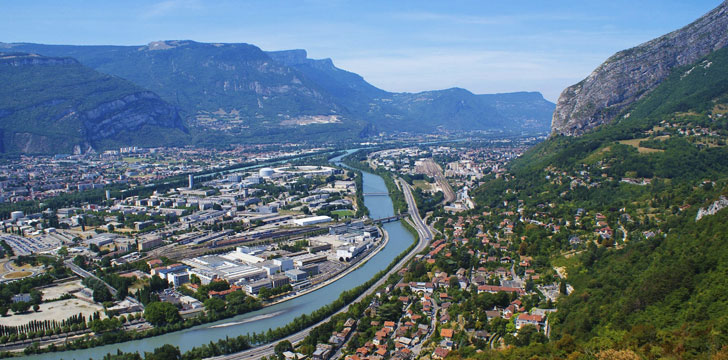
The Bastille above the city
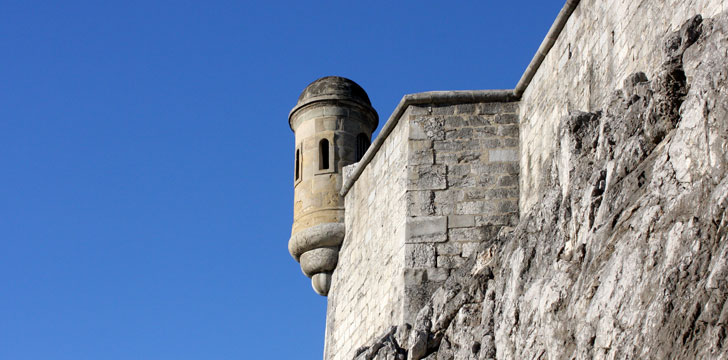
Fort de la Bastille occupies the lower slopes of the Chartreuse massif and overlooks central Grenoble. A cable car links the city centre with the fort, where the outlook takes in the urban area and the surrounding Vercors, Chartreuse and Belledonne ranges. The position explains the site’s military value as well as its place in Grenoble’s visitor landscape.
Historic Grenoble
Notre-Dame Cathedral traces its construction to the tenth century and forms a double church with neighbouring Saint-Hugues. Its most distinctive elements include a square brick bell-tower porch and a richly worked Flamboyant Gothic ciborium above the altar. The restrained exterior makes these surviving architectural details particularly important.
The former Palais du Parlement du Dauphiné records Grenoble’s judicial history. Built towards the end of the fifteenth century, it housed the Parlement of Dauphiné until the French Revolution. It subsequently served as the city’s law courts until 2002, when that institution moved to the Europole district.
Daily city life has its own landmarks. Halle Sainte-Claire is Grenoble’s principal covered market, while Place Victor-Hugo is framed by nineteenth-century buildings, fountains and planted public space. A statue of the Isère-born composer Hector Berlioz, made by Claude Grangé, stands at the centre of the square.
Museums and archaeology
The Musée Dauphinois approaches the history of Grenoble and the former Dauphiné through archaeology, ethnography and social history. Founded in 1906 in the former chapel of Sainte-Marie-d’en-Bas, its subject matter includes Alpine communities and the history of skiing. This regional perspective helps place the city within the wider mountain territory.
At the Musée archéologique Saint-Laurent, the setting is part of the collection. The museum occupies the former church of Saint-Laurent on an archaeological site whose layers extend from antiquity into the modern era. Its central feature is the sixth-century Saint-Oyand crypt, an important surviving element from the Merovingian period.
Parks and the surrounding massifs
Parc Paul-Mistral combines open space, sport and twentieth-century history. Laid out in the 1920s on former military ground, it was used for Grenoble’s 1925 international exhibition and later became an Olympic site for the 1968 Winter Games. Its sporting buildings and memorials reflect those different phases.
Beyond the city, the Chartreuse Regional Nature Park spans parts of Isère and Savoie between Grenoble, Voiron and Chambéry. The Vercors Regional Nature Park occupies the neighbouring massif and contains a landscape shaped by geology, climate and human activity. These protected areas broaden Grenoble’s context, though their paths and natural habitats call for considerate exploration.