
Things to see in Saint-Étienne
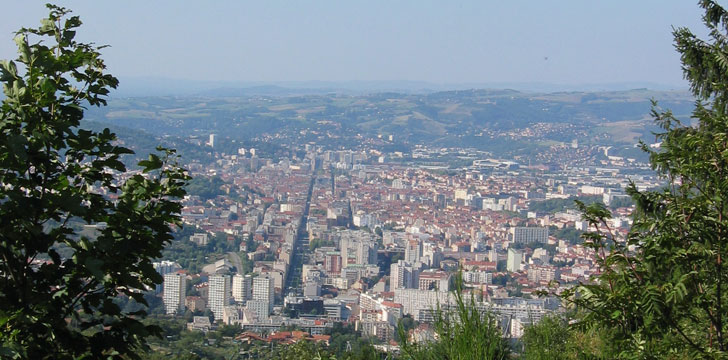
Coal mining, arms manufacture and textile production all shaped Saint-Étienne. The city’s reinvention has not erased that history: former industrial sites, specialist collections and workers’ districts provide some of its most informative visits. Religious buildings and nearby hill country add other layers to the city.
Old streets and churches
Rue des Martyrs de Vingré runs through the pedestrian area of old Saint-Étienne. Numbers 19 and 30 are eighteenth-century houses with workshops and distinctive raised stonework on their upper floors. Together with neighbouring Rue Denis-Escoffier, the street illustrates local urban architecture of the mid-eighteenth century, including exposed timbers and carefully arranged rooflines.
Saint-Charles Borromée Cathedral dates from 1922–23, although plans for a large church on the site go back to 1830. It was designed from plans by Pierre Bossan, the architect associated with Notre-Dame de Fourvière in Lyon, and has served as the diocesan seat since 1970.
The Chapelle de la Charité forms part of the Charité hospital complex. Built between 1708 and 1741 in Forez sandstone, its façade bears an allegory of Charity as a woman with three children. A small domed bell turret crowns the rectangular building. The church of Sainte-Marie occupies the site of a seventeenth-century Visitation convent and developed from a nuns’ chapel; successive alterations have left it with a Neo-Byzantine appearance. By contrast, the fifteenth-century Grand’Église is the city’s surviving example of Gothic architecture. It contains a Renaissance Entombment and a Flamboyant Gothic choir.
Mining, art and industry
The Musée de la Mine occupies Puits Couriot, a former pit worked until 1973 and employing as many as 1,500 miners at its busiest. Reconstructed galleries use machinery, sound and lighting to convey the working environment. The salle des pendus recalls the system by which miners suspended their clothes and equipment overhead.
At the Musée d’Art et d’Industrie, the collections connect manufactured objects with skilled craft. The bicycle section follows development from early draisiennes to modern cycles made with composite materials. Textile displays concentrate on trimmings and ribbon weaving, with period industrial looms used to explain production. Another section covers the former royal arms manufacture of Saint-Étienne.
The Musée d’Art Moderne focuses on twentieth-century art. Its displays trace the move towards abstraction between 1900 and 1945 and include work connected with Dada, Picasso, Delaunay, Miró, Max Ernst, Masson and Soulages. Later galleries address several post-1960 tendencies, among them geometric and lyrical abstraction, Pop Art, Art Brut and new approaches to everyday objects.
Crêt de Roc and the city’s hills
Crêt de Roc was the neighbourhood of ribbon and trimming makers and of gunsmiths. Its position on a hill gives views over Saint-Étienne and the surrounding area, while its workshops and streets retain a direct link with the occupations that supported the city.
Further out, the ruined Château de Rochetaillée is recorded from the twelfth century. Three of its original four towers remain on a rocky spur, making the defensive position visible from a considerable distance.
Gouffre d’Enfer and Grangent
A path towards the Gouffre d’Enfer follows the bed of a former torrent from beyond the Auberge de la Cascade. Rock walls narrow around the route before steps climb towards the dam and a viewpoint facing Château de Rochetaillée.
Grangent offers a separate excursion around the Loire. On the island, within the commune of Saint-Just-Saint-Rambert, Château de Grangent was erected in the ninth century on what was then a steep promontory above the river. The construction of the dam altered the original setting. Château d’Essalois occupies another commanding position above the lake, forming part of the same castle landscape described by the destination account.