
Things to see in Lyon
Lyon brings several periods of French urban history into a compact group of districts and hillsides. Once Lugdunum, a capital of Roman Gaul, the city later prospered through the silk trade and industry. Its surviving landmarks range from ancient performance spaces to Renaissance streets, major civic squares and museums devoted to art and cinema.
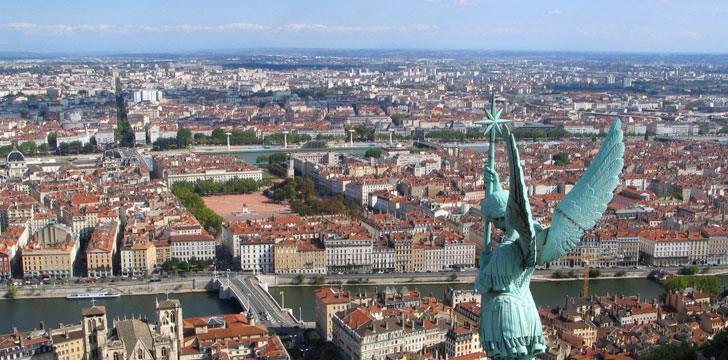
Vieux Lyon and Fourvière
At the foot of Fourvière hill, Vieux Lyon preserves narrow lanes, colourful façades and small shops amid medieval and Renaissance architecture. The district’s long survival was not assured: redevelopment proposals threatened it during the nineteenth and twentieth centuries. Today its street plan gives visitors a clear sense of the older city before the route rises towards Fourvière.
The Basilica of Notre-Dame de Fourvière was designed by Pierre Bossan in a Romanesque-Byzantine style and completed at the end of the nineteenth century. It occupies the site of an ancient forum. Its construction followed a vow made during the Franco-Prussian War, when Lyon’s inhabitants sought protection for the city; the building was completed in 1897.
Fourvière also holds important remains from Roman Lugdunum. The complex includes a theatre and odeon, while other traces associated with Roman Lyon include an amphitheatre and the Gier aqueduct. The theatre was first built under Augustus and later altered under Hadrian. Nearby, Saint-Jean Cathedral marks another historical layer: built between the late twelfth and late fifteenth centuries, it combines Romanesque and Gothic work and contains a fourteenth-century astronomical clock.
Squares and civic architecture
Place Bellecour is Lyon’s largest square, a broad pedestrian space with an equestrian statue of Louis XIV at its centre. A second monument on its western side depicts Antoine de Saint-Exupéry’s Little Prince. The contrasting sculptures make the square an useful orientation point for the city’s civic and literary associations.
Place des Terreaux brings several prominent buildings together. Lyon City Hall stands on its eastern side, the opera is opposite, and the Musée des Beaux-Arts occupies the Palais Saint-Pierre to the south. The square was laid out after losing its earlier defensive role and was redesigned in 1994 by Christian Drevet and Daniel Buren.
Inside the Musée des Beaux-Arts, the directory entry describes collections extending from ancient Egypt to modern art across more than seventy rooms. Paintings by Gauguin, Géricault, Monet and Cézanne sit alongside sculpture and religious art. The nearby opera building, redesigned by Jean Nouvel, is recognised by the large glazed structure above its older façades and houses Lyon’s opera and ballet companies.
Parks and the story of cinema
For a quieter change of scale, Parc de la Tête d’Or covers almost 120 hectares. Created by the Bühler brothers and inaugurated in the nineteenth century, it developed over time to include glasshouses, a rose garden, an orangery, sculpture and a botanical garden.
Lyon’s connection with early cinema is explored at the Musée Lumière. The Lumière brothers, who came from the city, developed the cinematograph, and the museum presents early cameras and films associated with their work. Together with the city’s Roman sites and later architecture, it adds an industrial and cultural chapter to a visit centred on Lyon’s built heritage.