
Things to see in Le Havre
Founded by Francis I, Le Havre is a Seine-Maritime port whose identity reflects the sea, its working history and the rebuilding that followed the Second World War. Churches from very different periods sit alongside harbour basins, art collections, historic domestic architecture and gardens overlooking the coast.
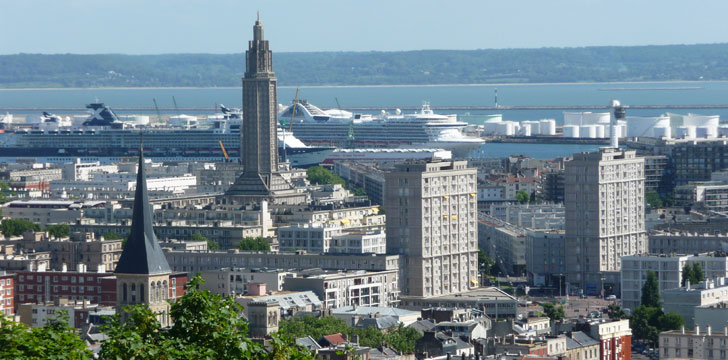
Two contrasting churches
Notre-Dame Cathedral was built between 1575 and 1638 and was one of the few buildings to survive the city’s wartime bombing. Its architecture combines Gothic, Renaissance and Baroque influences. The side façades are Classical in treatment, whereas the principal front is Baroque. Inside, stained glass depicts the Virgin, royal troops associated with the city’s release from English control, and Henri IV. The cathedral forecourt sits below the level of the rebuilt city, which rose over the ruins of its predecessor.
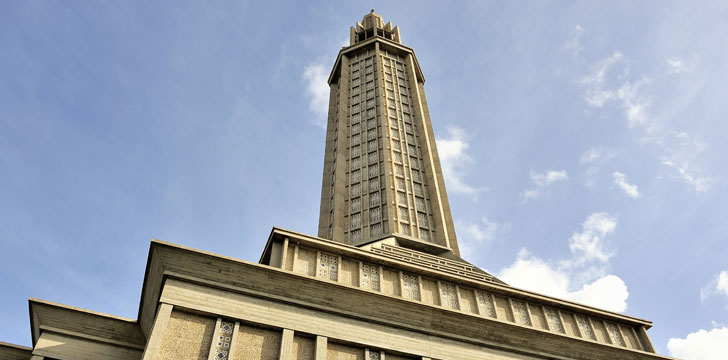
Saint-Joseph Church belongs to the reconstruction period. Built during the first half of the 1950s as a memorial to victims of the war, it is dominated by a tall lantern tower that directs daylight towards the altar. The building stands on seventy-one piles, each fifteen metres long, and its altar occupies the centre of the church.
Art, interiors and the abbey
The Musée des Beaux-Arts occupies a spare, modern building at the end of the harbour. Its collections include paintings by Monet, Renoir, Sisley, Braque, Sérusier and Tamara de Lempicka, as well as busts by Bourdelle, watercolours by Raoul Dufy and Degas, and Picasso’s The Beggar.
For a different view of the city’s past, the Maison de l’Armateur is an 18th-century, five-storey residence arranged in the Classical manner. Its period objects evoke everyday life under the Ancien Régime. Among the pieces described are a telescopic sextant, an engraved Dutch crystal glass and a model of the ship L’Adélaïde.
Graville Abbey began as an 11th-century priory formerly known as the Abbey of Sainte-Honorine. Set above the Seine estuary, the complex comprises a residence adapted as a museum and a cloister. Romanesque work survives in the nave and transept, while the choir dates from the 13th century.
Harbour, gardens and coast
The 18th-century Bassin du Commerce is one of the port basins. A metal footbridge by Guillaume Gillet crosses the water; the structure received an award for its engineering in 1972 and replaced a 19th-century bridge that had linked Saint-François with the business centre.
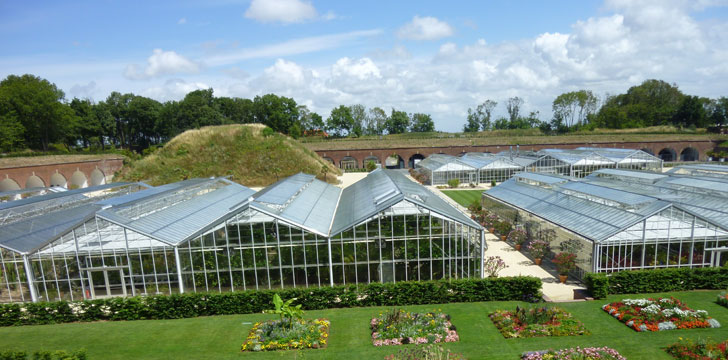
High above the city, the Jardins Suspendus occupy the former military fort at Sainte-Adresse. Their planting is organised by geographical origin, with Asian species such as rhododendrons and maples, southern-hemisphere eucalyptus and pines, an explorers’ garden containing jasmine and acacias, and glasshouses for tropical plants and palms.
Le Havre’s city-centre beach is edged by landscaped gardens designed by Alexandre Chemetoff. Farther north, Cap de la Hève marks the southern end of the Côte d’Albâtre. The headland rises to more than one hundred metres, carries a lighthouse and provides a vantage point for observing migratory birds.