
Things to see in Rouen
Rouen stands beside the Seine in Seine-Maritime, with a cityscape shaped by Gothic architecture and a long maritime history. Its churches, former ossuary and Renaissance town house provide the clearest introduction to the historic city, while its museums explore both art and the river port.
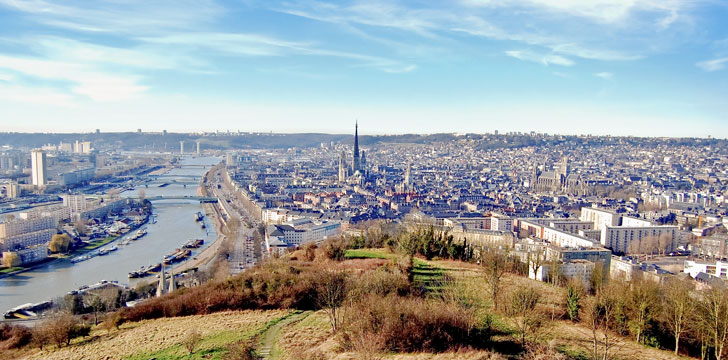
Cathedral and Gothic architecture
Work on Notre-Dame Cathedral began in 1030. The original Romanesque church was repeatedly altered and ultimately became a Gothic cathedral; its height makes it the tallest cathedral in France. The building also has a notable place in painting. Camille Pissarro depicted it within the roofs of old Rouen, and Claude Monet made it the subject of a series in the 1890s.
Saint-Ouen Abbey Church offers another major expression of Gothic design. Construction began early in the 14th century and was disrupted by the Hundred Years’ War. During the French Revolution the abbey was used as a factory; it later returned to worship and subsequently became a setting for exhibitions and concerts.
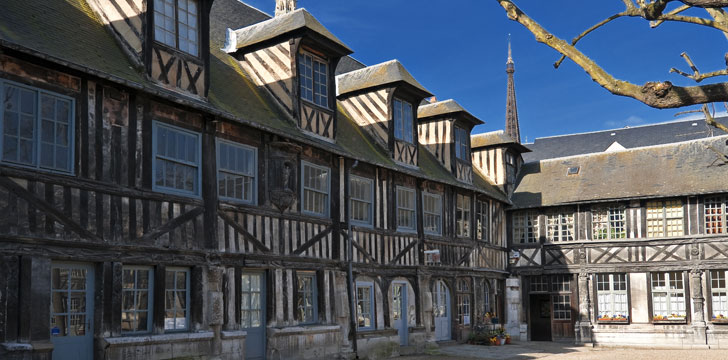
Saint-Maclou Church was begun in the mid-15th century and completed early in the 16th. Its Flamboyant Gothic fabric suffered heavy damage during the Second World War and underwent extensive restoration. Nearby, the Aître Saint-Maclou was built as an ossuary when the church cemetery lacked space. Four ranges enclose a square courtyard, and carved bones, skulls and dancing skeletons run across its timbers and columns.
Joan of Arc in Rouen
Place du Vieux-Marché is inseparable from the final chapter of Joan of Arc’s life: she was burned at the stake here. Half-timbered houses surround the square, which also contains a covered market hall with slate-framed forms intended to recall the sea.
The Tour Jeanne d’Arc is the sole surviving part of the fortified castle built by Philip Augustus in the early 13th century. Joan was questioned there repeatedly and threatened with torture during the investigation that preceded her trial. The circular tower reflects the military architecture associated with Philip Augustus, in which round towers replaced earlier square forms.
Renaissance Rouen and its museums
The Hôtel de Bourgtheroulde was constructed for the Le Roux family. Although principally Renaissance in character, it retains Gothic details such as pointed arches. Sculptures and pastoral bas-reliefs lost in bombing at the end of the Second World War were later reconstructed. After a period of use by a bank, the building was converted into a hotel in 2006.
Rouen’s maritime museum traces the port’s history through scale models of the river downstream from the city, material on tall ships, shipbuilding, inland navigation and the merchant navy. Its displays also include a whale skeleton made available by the city’s natural history museum.
At the Musée des Beaux-Arts, more than sixty rooms give particular weight to works from the 17th and 19th centuries. A 1909 donation from the Depeaux collection strengthened its Impressionist holdings. The works identified in the collection include Monet’s view of Rouen Cathedral, alongside paintings by Degas, Fantin-Latour, Puvis de Chavannes, Sisley and Renoir.