
Béziers: cathedral, Canal du Midi and city sights
Béziers lies in Hérault, not far from Montpellier, and has a history extending to antiquity. Viticulture, rugby and the city’s féria have all contributed to its modern identity, while the principal landmarks occupy the high ground above the Orb or follow the Canal du Midi below.
Cathedral, promenades and arenas
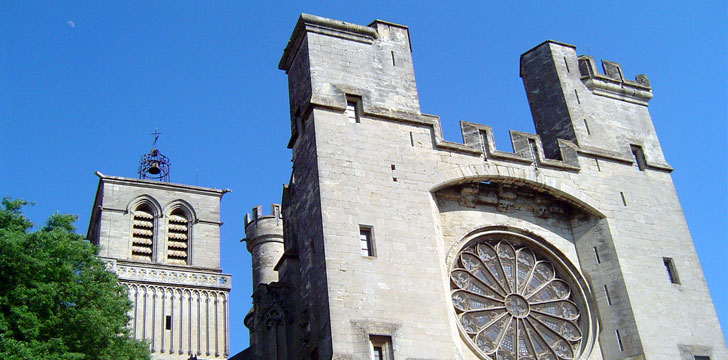
The 13th-century Cathédrale Saint-Nazaire occupies the hill above the Orb and is one of Béziers’ most visible buildings. The Gothic cathedral stands on the site of a Roman temple dedicated to Augustus and Livia. Dedicated to saints Nazaire and Celse, it contains six large paintings by the painter Thierry, showing scenes from the life of Moses. Twin towers and crenellations give the exterior the appearance of a fortress.
Basilique Saint-Aphrodise stands within the dense city centre. It takes its name from Aphrodise of Béziers, regarded as the city’s first bishop and a martyr. The church was badly damaged when crusaders took Béziers in 1209 during the campaign against the Cathars. Later rebuilding left a predominantly Romanesque structure with pointed windows that recall Gothic architecture.
Allées Paul Riquet honour the engineer responsible for the Canal du Midi. Known simply as La Promenade in the 18th century, it was called the promenade du théâtre a century later, after the Italian-style theatre along it. Haussmann-era buildings and neoclassical façades now line the esplanade. Its continuation, Plateau des Poètes, is an English-style garden created by the Bühler landscape designers late in the 19th century. It has an artificial lake, varied trees and busts of writers including Jean Laurès and Victor Hugo.
Béziers has remains of a Roman arena as well as a much later bullring. The ancient structure was used as a quarry in the Middle Ages, leaving archaeological fragments. The modern arena was built at the end of the 19th century with backing from a local patron whose fortune came from wine. Designed for more than 15,000 spectators, it has hosted bull events, opera and concerts.
The Canal du Midi and the Orb
Pierre-Paul Riquet built the Canal du Midi under Louis XIV to connect the Garonne with the Mediterranean, a route of almost 250 kilometres. Around Béziers, its engineering works are as important as the towpath itself. They include the Fonséranes locks and the bridge carrying the canal across the Orb.
Pont-Canal de l’Orb is a stone structure almost 250 metres long. Opened in 1858, it allowed boats to cross above the Orb rather than enter a river whose changing conditions made navigation difficult. The work is both bridge and water channel, and is one of the larger canal bridges built in France.
At the foot of the city, the Écluses de Fonséranes negotiate a 21-metre change in level through seven locks. Their ovoid basins form a close sequence, each raising the canal by roughly three metres. The original work contained nine locks; later changes reduced the number of basins as the navigation was adapted for larger boats.
Festival traditions and Fontcaude
The féria is a major expression of local identity. White clothing and red neckerchiefs are traditional, while brass bands, open-air bars and events at the arena bring activity into the centre. Its bull-related programme is part of the festival’s established character.
Outside the central circuit, Abbaye de Fontcaude is a 13th-century Romanesque complex associated with Abbot Bernard de Fontcaude. It includes a church, cloister, oratory and mill. After centuries of abandonment, the abbey was restored in the 1970s. A bell-foundry museum presents sculpture and other pieces made at the site, some dating from the 16th century.