
Montpellier: historic centre and architectural landmarks
Montpellier, the administrative centre of Hérault, grew at a crossroads between routes towards Italy and Spain. Its architecture reflects medieval and royal periods as well as ambitious 20th-century planning. The Écusson is the compact historic core. From there, older streets lead west to Peyrou, while the later Antigone district extends to the east.
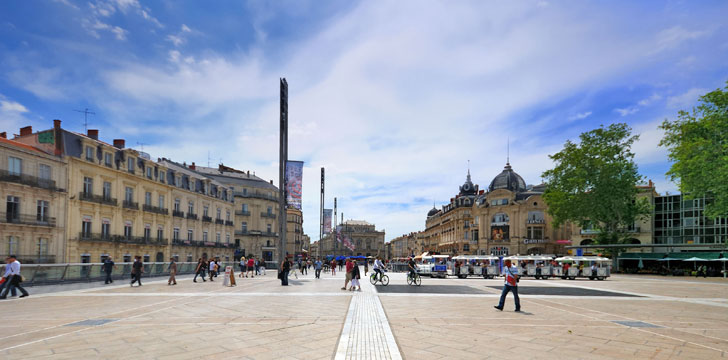
Place de la Comédie and the Écusson
Place de la Comédie is the city’s large central square, edged by cafés, restaurants and cinemas. The theatre that gave the square its name dominates one side. Tram lines cross the area, and the railway station is a short walk away, making the square an important point of orientation as well as a social space.
Opéra Comédie was designed by Joseph-Marie Cassien-Bernard. Above its entrance are three glazed bays, while four façade statues represent Song, Poetry, Tragedy and Comedy. The internal arrangement is unusual: a concert hall lies perpendicular to the main auditorium rather than directly behind it.
On the northern side of the old centre, Cathédrale Saint-Pierre has the mass of a medieval fortress. Pope Urban V commissioned the 14th-century building, whose porch projects between two large towers. The cathedral was repeatedly attacked during the Wars of Religion. Montpellier’s faculty of medicine, described as one of the oldest in France, adjoins the church.
Musée Fabre brings another layer to the centre. The Fabre family, benefactors of Montpellier, helped establish it. Its collections range from Renaissance sculpture to Flemish and Dutch paintings. Romantic and historical painting also feature, alongside work associated with Pierre Soulages.
Peyrou and Montpellier’s waterworks
Porte du Peyrou marks the entrance to the royal promenade dedicated to Louis XIV. François II d’Orbay drew the triumphal arch and Augustin-Charles d’Aviler oversaw its construction. Erected in 1691 on one of Montpellier’s highest points, it frames the approach to the broad promenade beyond.
At the far end, the hexagonal Château d’Eau is ringed by Corinthian columns. Henri Pitot designed the structure in the 18th century to distribute drinking water brought from the Lez. The Aqueduc Saint-Clément, also known in the city as the Aqueduc des Arceaux, connected the water tower with the directory entry near Saint-Clément. Built on the model of the Pont du Gard, the 14-kilometre work was completed in 1754 and ends in arches rising more than 20 metres.
Architecture beyond the old centre
Château de la Mogère represents the country houses built for aristocratic and wealthy families in the early 18th century. It remained with the same family after its construction. Its rooms contain 17th- and 18th-century furnishings and portraits of local notables, including Mignard’s depiction of Louis XIV before Maastricht.
East of the Écusson, Place de l’Europe is a focal point of Antigone, the neoclassical district designed by Ricardo Bofill from 1977. Greek references shape the esplanade and its long perspectives, which include replicas of classical statues such as the Winged Victory of Samothrace.
Parc Zoologique Henri de Lunaret occupies more than 80 hectares on higher ground. Henri de Lunaret left the property to Montpellier, and its landscape retains areas of garrigue and vines. The setting also opens views over the countryside behind the city.